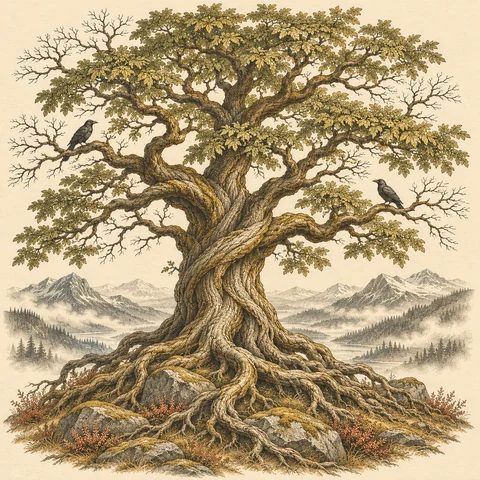
A world of relations
Völuspá names a great ash, Yggdrasil, and places the norns near the well beneath it. Grímnismál describes roots extending in different directions and a population of creatures: deer above, a serpent below, and a squirrel carrying words between. Snorri adds these materials to a prose account of the gods’ daily assembly.
The tree is useful for understanding connections, but the sources do not hand us a single consistent modern map with nine labeled planets on branches. A diagram that does so is an interpretation. This atlas instead links the particular relationships and locations attested in the chosen passages.
Sources: The Poetic Edda (1923 translation); The Younger Edda / Prose Edda (1901 printing) · Völuspá 19–20; Grímnismál 29–35; Gylfaginning, chapter VII, §§15–16 in Anderson
Care, damage, and uncertainty
The tree suffers from grazing, decay, and gnawing. In Snorri’s account the norns care for it with water and material from the well. At the final crisis it shakes. Its endurance is not the same as immunity from harm.
Odin’s hanging in Hávamál is frequently located on Yggdrasil in modern retellings. The passage itself says the speaker hung on a tree and does not name it. Connecting the unnamed tree to Yggdrasil may be a reasonable interpretation, but it should be identified as such. Separating explicit names from inference makes the story easier to examine, not less compelling.
Sources: The Poetic Edda (1923 translation); The Younger Edda / Prose Edda (1901 printing) · Grímnismál 35; Hávamál 139–142; Völuspá 47; Gylfaginning, chapter VII, §16
- Period / witness
- Poetic Edda witnesses chiefly thirteenth century CE; Prose Edda composed c.1220 and preserved in later copies. Mythic events are undated.
- Recording context
- Medieval Icelandic textual preservation; the principal Poetic Edda manuscript, Codex Regius, dates to c.1270. Recording and copying locations do not establish the birthplace of a story.
A recording location is not necessarily a story’s origin. Dates of texts, copies, and translations answer different questions.
Explore time & place →Read the sources
These references support the explanation above. Rights and edition notes are recorded individually.
The Poetic Edda (1923 translation) ↗
Anonymous Old Norse poets; translated by Henry Adams Bellows (1885–1939) · 1923 translation; medieval poems preserved principally in manuscripts of the thirteenth century
Edition & rights noteThe Younger Edda / Prose Edda (1901 printing) ↗
Snorri Sturluson (1179–1241); translated by Rasmus B. Anderson (1846–1936) · 1901 printing of Anderson’s translation (copyright 1879); medieval work composed in Iceland around the 1220s
Edition & rights note