Knowledge has a cost
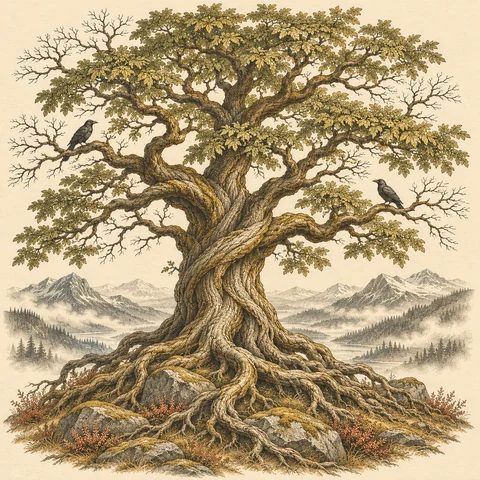
Odin appears under many names in the poems. He questions a seeress in Völuspá, contests knowledge with a giant in Vafþrúðnismál, and speaks about wisdom and conduct in Hávamál. The famous account in Hávamál 138–141 has the speaker hang wounded on a tree for nine nights and acquire runes. Its language identifies the offering as Odin’s to Odin, making sacrifice and recipient unusually entangled. The poem does not explicitly name that tree Yggdrasil in this passage.
Other knowledge comes through deception. Odin acquires the mead of poetry at Gunnlöð’s expense. The texts can celebrate his success while allowing the damage he causes to remain visible.
Source: The Poetic Edda (1923 translation) · Völuspá 28–30; Hávamál 104–110, 139–142; Vafþrúðnismál 1–5, 54–55
Power without immunity
In Snorri’s presentation Odin occupies a leading position among the gods, but leadership does not grant safety. The wolf kills him at Ragnarök; Víðarr avenges him. A figure who seeks knowledge of what is coming cannot simply abolish the future he learns.
Descriptions such as “god of wisdom” are useful entry points, not a full inventory or exclusive portfolio. These works distribute wisdom, poetry, battle, and foreknowledge across multiple beings. Nor is Odin a documentary portrait of every historical worshipper’s beliefs. This page follows selected medieval literary witnesses, with their changes of speaker, genre, and purpose.
Sources: The Poetic Edda (1923 translation); The Younger Edda / Prose Edda (1901 printing) · Völuspá 53–54; Gylfaginning, chapter XVI, §56
- Period / witness
- Poetic Edda witnesses chiefly thirteenth century CE; Prose Edda composed c.1220 and preserved in later copies. Mythic events are undated.
- Recording context
- Medieval Icelandic textual preservation; the principal Poetic Edda manuscript, Codex Regius, dates to c.1270. Recording and copying locations do not establish the birthplace of a story.
A recording location is not necessarily a story’s origin. Dates of texts, copies, and translations answer different questions.
Explore time & place →Read the sources
These references support the explanation above. Rights and edition notes are recorded individually.
The Poetic Edda (1923 translation) ↗
Anonymous Old Norse poets; translated by Henry Adams Bellows (1885–1939) · 1923 translation; medieval poems preserved principally in manuscripts of the thirteenth century
Edition & rights noteThe Younger Edda / Prose Edda (1901 printing) ↗
Snorri Sturluson (1179–1241); translated by Rasmus B. Anderson (1846–1936) · 1901 printing of Anderson’s translation (copyright 1879); medieval work composed in Iceland around the 1220s
Edition & rights note