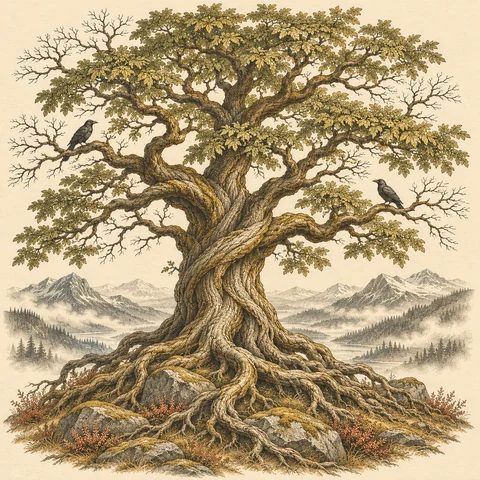
A messenger on Yggdrasil
Grímnismál names Ratatoskr as the squirrel that runs along Yggdrasil. He carries the eagle’s words from above to Níðhöggr below. The stanza is short, but its direction is precise: the tree becomes a route of communication between creatures occupying different levels of the cosmos.
The eagle is not named in this passage, and Ratatoskr is not supplied with a family, an origin, or a separate quest. His importance comes from an activity repeated within the tree’s living arrangement. The modest scale of the notice is worth preserving. It offers a clear role without requiring a newly invented adventure to justify the creature’s place in the atlas.
Source: The Poetic Edda (1923 translation) · Grímnismál 31–32
What the prose adds to the words
Gylfaginning describes Ratatoskr running up and down and carrying hostile words between eagle and Níðhöggr. That formulation makes the communication reciprocal and explicitly antagonistic. The poem’s verse, by itself, states the downward movement of the eagle’s words without spelling out their content in the same way.
The distinction is small but consequential. Calling the squirrel an inventor of lies or saying that he deliberately causes Ragnarök would add motives and effects absent from these passages. Snorri supplies hostility in what is transmitted; he does not give a speech in which Ratatoskr explains why he does it. Modern readers can recognize the destructive potential of repeated insults while keeping that interpretation separate from an unattested biography.
Sources: The Younger Edda / Prose Edda (1901 printing); The Poetic Edda (1923 translation) · Gylfaginning, chapter VII, §16 in Anderson; Grímnismál 32
The tree as an inhabited system
Ratatoskr belongs beside the deer feeding above, the serpents below, and the eagle in the branches. Their movements make Yggdrasil more than a static diagram of stacked regions. It is a structure under pressure, inhabited by beings whose activities do not all preserve it. The norns’ tending of the tree provides a different kind of repeated action within the same prose description.
Reading the squirrel in this company shifts attention from how large a creature is to what it connects. A small runner can carry speech across a vast vertical distance. The texts give that image a place in their account of the world without explaining it as a universal moral fable about gossip.
Sources: The Poetic Edda (1923 translation); The Younger Edda / Prose Edda (1901 printing) · Grímnismál 32–35; Gylfaginning, chapter VII, §16 in Anderson
- Period / witness
- Medieval Old Norse literature; the Poetic Edda survives chiefly in thirteenth-century copies, and Snorri’s Edda was composed around the 1220s. Mythic events have no historical date.
- Recording context
- Preserved through medieval Icelandic writing and later copies, in a Christian literary culture. Codex Regius of the Poetic Edda dates to c.1270. These recording circumstances do not locate the origin of an oral story.
A recording location is not necessarily a story’s origin. Dates of texts, copies, and translations answer different questions.
Explore time & place →Read the sources
These references support the explanation above. Rights and edition notes are recorded individually.
The Poetic Edda (1923 translation) ↗
Anonymous Old Norse poets; translated by Henry Adams Bellows (1885–1939) · 1923 translation; medieval poems preserved principally in manuscripts of the thirteenth century
Edition & rights noteThe Younger Edda / Prose Edda (1901 printing) ↗
Snorri Sturluson (1179–1241); translated by Rasmus B. Anderson (1846–1936) · 1901 printing of Anderson’s translation (copyright 1879); medieval work composed in Iceland around the 1220s
Edition & rights note