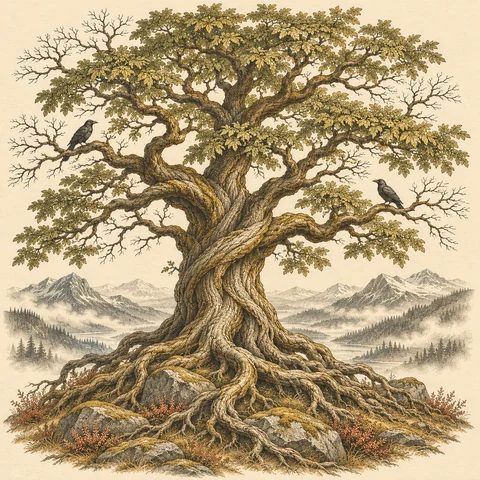
Between cold and heat
In the prose account, the beginning is a gap between regions of cold and heat. As frost meets warmth, a living being takes shape: Ymir, ancestor of the frost giants. He is fed by the cow Auðhumla, who herself licks salty frost-covered stones. Her licking gradually reveals another being, Búri. His line leads to Borr and to Borr’s sons Odin, Vili, and Vé. The world therefore begins through several kinds of generation, rather than through one maker creating everything from nothing.
The brothers kill Ymir. His blood overwhelms the giants, though Bergelmir and his household escape in the prose narrative. The victors carry Ymir into the gap and build a habitable world from him: flesh becomes earth, blood becomes waters, bones become mountains, and his skull becomes the sky. His eyebrows form a protective boundary for human habitation. The landscape is fashioned from an earlier life, and the new order rests on an act of violence.
Source: The Younger Edda / Prose Edda (1901 printing) · Gylfaginning, chapter IV, §§4–8 in Anderson
Giving people a place
After shaping the world, the gods encounter two pieces of wood on the shore and make the first human pair, Ask and Embla. The prose account assigns the gifts of life, understanding, and bodily faculties among Borr’s three sons. Völuspá tells the human episode differently: Odin, Hœnir, and Lóðurr give vital capacities to Ask and Embla, who initially lack them. The poem names the recipients and donors, but does not supply every detail of Snorri’s prose scene.
The difference matters. A merged illustration that labels Odin, Vili, and Vé as the only possible creators of humanity would silently replace one witness with another. These are related presentations, not interchangeable transcripts of a single original story.
Sources: The Poetic Edda (1923 translation); The Younger Edda / Prose Edda (1901 printing) · Völuspá 17–18; Gylfaginning, chapter V, §9 in Anderson
What the story explains—and what it cannot date
Ymir’s transformation connects the human world to the beings whom the gods later oppose. In this literary cosmos, kinship and antagonism coexist. Calling the giants simply a separate race of evil monsters misses that dependence. Snorri’s speakers do make hostile judgments about them; those judgments belong to the narrative voice and should not be converted into a modern biological category.
The creation episode takes place before ordinary time inside the story. It is not an event that can be assigned an archaeological date. Vafþrúðnismál and Grímnismál also preserve compressed accounts of the body becoming the world. Reading those verses beside the prose exposes how Snorri orders scattered poetic information into a continuous explanation.
Sources: The Poetic Edda (1923 translation); The Younger Edda / Prose Edda (1901 printing) · Vafþrúðnismál 20–21, 28–35; Grímnismál 40–41; Gylfaginning, chapters IV–V
One story, different sources
Choose a textual witness. The summary, diagram, and cited connections below change together. This is a selective map of claims, not a complete family tree.
Völuspá · the gifts to humanity
The poem names Odin, Hœnir, and Lóðurr as the three donors of human capacities. It does not name Vili and Vé in this episode.
Source: The Poetic Edda (1923 translation) · Völuspá 17–18
Cited connections 3
Odin gives breath Ask and Embla
Source: The Poetic Edda (1923 translation) · Völuspá 18
Hœnir gives understanding Ask and Embla
Source: The Poetic Edda (1923 translation) · Völuspá 18
Lóðurr gives bodily vitality and appearance Ask and Embla
Source: The Poetic Edda (1923 translation) · Völuspá 18; translation of the capacities varies
Gylfaginning · Borr’s three sons
The prose identifies the creators as Borr’s sons, earlier named Odin, Vili, and Vé. It distributes gifts among first, second, and third without repeating their names at each gift.
Source: The Younger Edda / Prose Edda (1901 printing) · Gylfaginning, chapter IV, §6; chapter V, §9 in Anderson
Cited connections 3
Odin one of the three makers Ask and Embla
Source: The Younger Edda / Prose Edda (1901 printing) · Gylfaginning, chapter IV, §6; chapter V, §9
Vili one of the three makers Ask and Embla
Source: The Younger Edda / Prose Edda (1901 printing) · Gylfaginning, chapter IV, §6; chapter V, §9
Vé one of the three makers Ask and Embla
Source: The Younger Edda / Prose Edda (1901 printing) · Gylfaginning, chapter IV, §6; chapter V, §9
See what differs across the witnesses
Völuspá · the gifts to humanity
The poem names Odin, Hœnir, and Lóðurr as the three donors of human capacities. It does not name Vili and Vé in this episode.
Source: The Poetic Edda (1923 translation) · Völuspá 17–18
Gylfaginning · Borr’s three sons
The prose identifies the creators as Borr’s sons, earlier named Odin, Vili, and Vé. It distributes gifts among first, second, and third without repeating their names at each gift.
Source: The Younger Edda / Prose Edda (1901 printing) · Gylfaginning, chapter IV, §6; chapter V, §9 in Anderson
- Period / witness
- Poetic Edda witnesses chiefly thirteenth century CE; Prose Edda composed c.1220 and preserved in later copies. Mythic events are undated.
- Recording context
- Medieval Icelandic textual preservation; the principal Poetic Edda manuscript, Codex Regius, dates to c.1270. Recording and copying locations do not establish the birthplace of a story.
A recording location is not necessarily a story’s origin. Dates of texts, copies, and translations answer different questions.
Explore time & place →Read the sources
These references support the explanation above. Rights and edition notes are recorded individually.
The Younger Edda / Prose Edda (1901 printing) ↗
Snorri Sturluson (1179–1241); translated by Rasmus B. Anderson (1846–1936) · 1901 printing of Anderson’s translation (copyright 1879); medieval work composed in Iceland around the 1220s
Edition & rights noteThe Poetic Edda (1923 translation) ↗
Anonymous Old Norse poets; translated by Henry Adams Bellows (1885–1939) · 1923 translation; medieval poems preserved principally in manuscripts of the thirteenth century
Edition & rights note