Below the tree
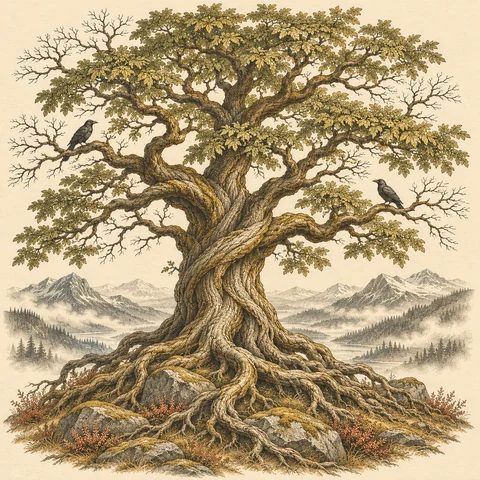
Grímnismál places Níðhöggr beneath Yggdrasil, gnawing from below while other creatures damage the tree above. Ratatoskr runs between the eagle in the tree and Níðhöggr, carrying hostile words. This is a living, contentious environment, not an unchanging diagram of perfectly balanced cosmic zones.
Gylfaginning gathers the tree’s creatures and injuries into its explanation of the gods’ meeting place. The presence of the serpent helps show that the cosmic structure requires care and remains vulnerable. It does not establish that Níðhöggr alone will cause Ragnarök.
Sources: The Poetic Edda (1923 translation); The Younger Edda / Prose Edda (1901 printing) · Grímnismál 32, 35; Gylfaginning, chapter VII, §16 in Anderson
At an unsettling ending
Völuspá associates Níðhöggr with the dead and ends, in Bellows’s arrangement, with an image of the creature flying with corpses. This comes after visions of a renewed green earth and splendid halls. Readers therefore face an ending that does not settle into uncomplicated reassurance.
The exact relationship of the final image to the preceding renewal has invited interpretation. It may change how the ending feels without proving that another complete cycle of destruction is explicitly foretold. The atlas distinguishes the textual image from a proposed explanation of it. Calling Níðhöggr simply “the Norse dragon of evil” substitutes an abstract category for those specific and puzzling roles.
Source: The Poetic Edda (1923 translation) · Völuspá 39, 66; stanza numbering follows Bellows
- Period / witness
- Poetic Edda witnesses chiefly thirteenth century CE; Prose Edda composed c.1220 and preserved in later copies. Mythic events are undated.
- Recording context
- Medieval Icelandic textual preservation; the principal Poetic Edda manuscript, Codex Regius, dates to c.1270. Recording and copying locations do not establish the birthplace of a story.
A recording location is not necessarily a story’s origin. Dates of texts, copies, and translations answer different questions.
Explore time & place →Read the sources
These references support the explanation above. Rights and edition notes are recorded individually.
The Poetic Edda (1923 translation) ↗
Anonymous Old Norse poets; translated by Henry Adams Bellows (1885–1939) · 1923 translation; medieval poems preserved principally in manuscripts of the thirteenth century
Edition & rights noteThe Younger Edda / Prose Edda (1901 printing) ↗
Snorri Sturluson (1179–1241); translated by Rasmus B. Anderson (1846–1936) · 1901 printing of Anderson’s translation (copyright 1879); medieval work composed in Iceland around the 1220s
Edition & rights note