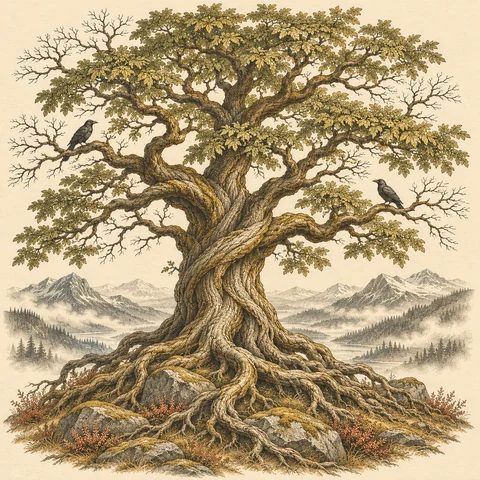
An enclosure with many stories
Ásgarðr names the gods’ enclosure or dwelling region in the literary record. Within the broader descriptions of divine space are particular halls, seats, and meeting places; these names are not all synonyms for one building. Hymiskviða has Thor and Týr leave Asgard on their expedition, while Gylfaginning connects the place with the gods’ arrangements after the world is formed.
The enclosure is also vulnerable. In Snorri’s builder episode, a bargain for fortifications puts Freyja and the heavenly lights at risk; Loki’s intervention prevents the builder from completing the work on the promised terms. Protection can be won through the breaking or manipulation of agreements.
Sources: The Poetic Edda (1923 translation); The Younger Edda / Prose Edda (1901 printing) · Hymiskviða 7; Gylfaginning, chapter V, §9; chapter XIII, §43 in Anderson
Do not place the myth on a modern map
The Prose Edda’s prologue also explains the gods through a learned story of migration and rulers associated with Troy. That framing is part of medieval interpretation, not evidence that archaeologists have located the divine enclosure. Narrative geography, a writer’s historical explanation, and a manuscript’s recording location need separate labels.
The surviving Prose Edda exists in multiple manuscript versions. Utrecht’s account of the Codex Trajectinus illustrates this transmission: an Icelandic copy reached a Dutch collection through later owners. Neither Utrecht nor the manuscript’s Icelandic home becomes the geographical origin of Asgard merely by preserving its story.
Sources: The Younger Edda / Prose Edda (1901 printing); The Codex Trajectinus of the Prose Edda · Prologue §§9–13; Utrecht University Library, “The manuscripts of the Prose Edda” and manuscript history
- Period / witness
- Poetic Edda witnesses chiefly thirteenth century CE; Prose Edda composed c.1220 and preserved in later copies. Mythic events are undated.
- Recording context
- Medieval Icelandic textual preservation; the principal Poetic Edda manuscript, Codex Regius, dates to c.1270. Recording and copying locations do not establish the birthplace of a story.
A recording location is not necessarily a story’s origin. Dates of texts, copies, and translations answer different questions.
Explore time & place →Read the sources
These references support the explanation above. Rights and edition notes are recorded individually.
The Poetic Edda (1923 translation) ↗
Anonymous Old Norse poets; translated by Henry Adams Bellows (1885–1939) · 1923 translation; medieval poems preserved principally in manuscripts of the thirteenth century
Edition & rights noteThe Younger Edda / Prose Edda (1901 printing) ↗
Snorri Sturluson (1179–1241); translated by Rasmus B. Anderson (1846–1936) · 1901 printing of Anderson’s translation (copyright 1879); medieval work composed in Iceland around the 1220s
Edition & rights note