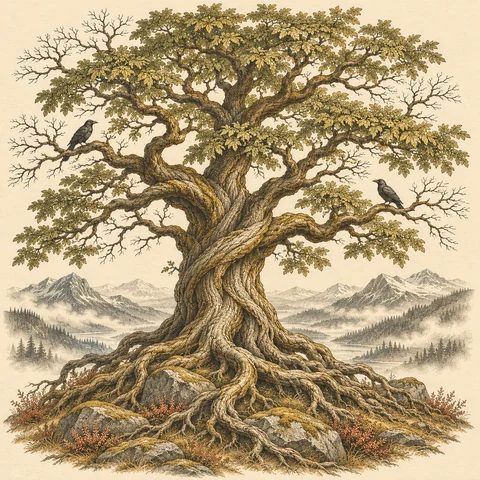
Three named women beside the tree
Völuspá places three knowledgeable women beneath the great ash: Urðr, Verðandi, and Skuld. They establish laws, shape lives, and determine destinies, with an image of marking or cutting wood. Their work belongs near the foundational structures of the world, rather than in the court of a human king.
The names are often presented as a neat past, present, and future triad. That familiar explanation can be a useful introduction, but the poem does not divide every narrated action into three exclusive chronological departments. Its emphasis falls on the women’s joint authority over lives. A diagram should not invent separate occupations that the stanza does not assign.
Source: The Poetic Edda (1923 translation) · Völuspá 19–20
More than a single trio
Gylfaginning explicitly adds other norns who come at a person’s birth and shape a life. It distinguishes beings associated with gods, elves, and dwarfs, citing a verse also found in Fáfnismál. In that poem, the dying dragon answers Sigurðr’s question about those who aid in childbirth by describing norns of different descent.
This wider population prevents the three famous names from exhausting the category. Snorri’s dialogue also asks why human fortunes are so unequal if norns distribute them. Its answer attributes good and bad lives to different kinds of norns. That is an explanation offered within the medieval dialogue, not an ethical judgment the atlas applies to people who experience misfortune.
Sources: The Younger Edda / Prose Edda (1901 printing); The Poetic Edda (1923 translation) · Gylfaginning, chapter VII, §15 in Anderson; Fáfnismál 12–13
Maintaining what is under strain
The norns by Urðr’s well also tend Yggdrasil in Snorri’s account, applying water and material from the well so that the tree does not decay. Their activity answers the damage caused by the creatures that feed on it. Fate and care appear together: the beings who shape lives also help maintain the structure that supports the inhabited cosmos.
These passages offer several complementary roles, not a complete philosophical system resolving every question about free choice. The texts can present predictions as certain while still making decisions and consequences matter within individual stories. Treating “the Norns” as a single machine that mechanically explains every action would flatten that narrative variety.
Sources: The Younger Edda / Prose Edda (1901 printing); The Poetic Edda (1923 translation) · Gylfaginning, chapter VII, §§15–16 in Anderson; compare Völuspá 19–20
- Period / witness
- Medieval Old Norse literature; the Poetic Edda survives chiefly in thirteenth-century copies, and Snorri’s Edda was composed around the 1220s. Mythic events have no historical date.
- Recording context
- Preserved through medieval Icelandic writing and later copies, in a Christian literary culture. Codex Regius of the Poetic Edda dates to c.1270. These recording circumstances do not locate the origin of an oral story.
A recording location is not necessarily a story’s origin. Dates of texts, copies, and translations answer different questions.
Explore time & place →Read the sources
These references support the explanation above. Rights and edition notes are recorded individually.
The Poetic Edda (1923 translation) ↗
Anonymous Old Norse poets; translated by Henry Adams Bellows (1885–1939) · 1923 translation; medieval poems preserved principally in manuscripts of the thirteenth century
Edition & rights noteThe Younger Edda / Prose Edda (1901 printing) ↗
Snorri Sturluson (1179–1241); translated by Rasmus B. Anderson (1846–1936) · 1901 printing of Anderson’s translation (copyright 1879); medieval work composed in Iceland around the 1220s
Edition & rights note