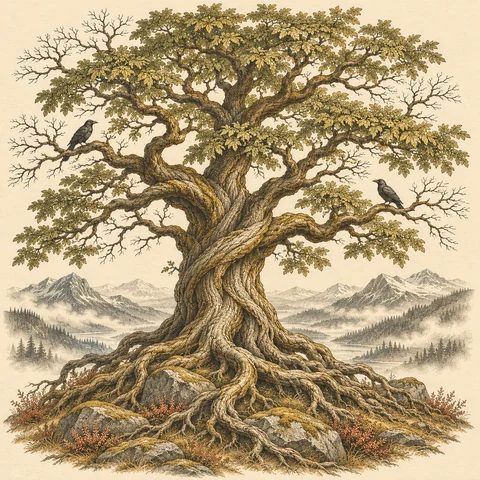
The well and Odin’s pledge
Gylfaginning locates Mímir’s well beneath a root of Yggdrasil extending toward the giants. The well contains wisdom, and Mímir drinks from it. Odin seeks a drink but must leave one of his eyes as a pledge. Knowledge therefore has a cost even for a god who repeatedly appears as an authority on the cosmos.
Völuspá also refers to Odin’s hidden eye and Mímir’s drinking from the pledge. Its compressed poetic language does not stage the entire transaction as a dialogue. Snorri’s explanation gives the allusion a connected setting, while the poem retains the force of a secret the prophetic speaker knows about her divine listener.
Sources: The Younger Edda / Prose Edda (1901 printing); The Poetic Edda (1923 translation) · Gylfaginning, chapter VII, §15 in Anderson; Völuspá 28–29
The hostage whose head keeps speaking
Ynglinga saga supplies another story. Mímir accompanies Hœnir as a hostage sent to the Vanir after war. Hœnir becomes their leader but relies on Mímir’s advice. When the Vanir suspect that the exchange has cheated them, they behead Mímir and send his head to the Æsir.
Odin preserves the head with herbs and empowers it with spoken charms so that it can tell him hidden things. A later chapter says that the head reports news from other worlds. The political attempt to destroy a source of counsel therefore produces another form in which counsel continues. Mímir’s body is lost, but his knowledge remains useful to Odin.
Source: Ynglinga saga, Finnur Jónsson’s Old Norse edition · Ynglinga saga, chapters 4 and 7
A connection, not a seamless biography
Völuspá mentions Odin speaking with Mímir’s head as the world’s crisis approaches. That notice supports the importance of the speaking head, but it does not independently recount the hostage exchange. Likewise, the well passage does not say when beheading occurred in relation to the eye pledge.
These connections invite comparison without authorizing an invented chronological bridge between every episode. The witnesses repeatedly locate wisdom beyond Odin’s unaided possession: he must pay, consult, preserve, or seek it. Mímir’s different forms make that dependency visible. A complete family tree or step-by-step life history would exceed what these particular passages establish, even when the overall association with counsel is unmistakable.
Sources: The Poetic Edda (1923 translation); The Younger Edda / Prose Edda (1901 printing); Ynglinga saga, Finnur Jónsson’s Old Norse edition · Völuspá 47; Gylfaginning, chapter VII, §15 in Anderson; Ynglinga saga, chapters 4 and 7
- Period / witness
- Medieval Old Norse literature; the Poetic Edda survives chiefly in thirteenth-century copies, and Snorri’s Edda was composed around the 1220s. Mythic events have no historical date.
- Recording context
- Preserved through medieval Icelandic writing and later copies, in a Christian literary culture. Codex Regius of the Poetic Edda dates to c.1270. These recording circumstances do not locate the origin of an oral story.
A recording location is not necessarily a story’s origin. Dates of texts, copies, and translations answer different questions.
Explore time & place →Read the sources
These references support the explanation above. Rights and edition notes are recorded individually.
The Younger Edda / Prose Edda (1901 printing) ↗
Snorri Sturluson (1179–1241); translated by Rasmus B. Anderson (1846–1936) · 1901 printing of Anderson’s translation (copyright 1879); medieval work composed in Iceland around the 1220s
Edition & rights noteThe Poetic Edda (1923 translation) ↗
Anonymous Old Norse poets; translated by Henry Adams Bellows (1885–1939) · 1923 translation; medieval poems preserved principally in manuscripts of the thirteenth century
Edition & rights noteYnglinga saga, Finnur Jónsson’s Old Norse edition ↗
Attributed to Snorri Sturluson (1179–1241); edited by Finnur Jónsson (1858–1934) · Medieval Icelandic work, early thirteenth century; Finnur Jónsson’s Heimskringla I–IV published 1893–1900
Edition & rights note