The speaker on the tree
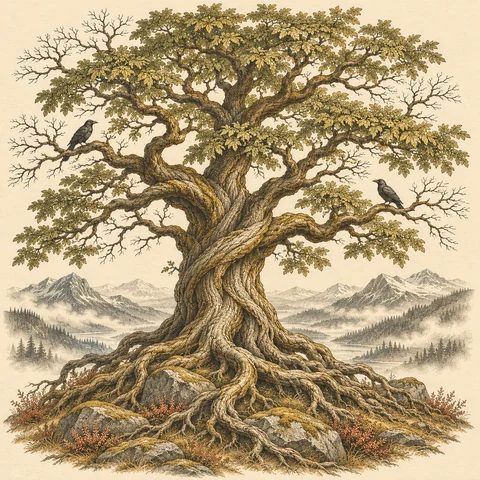
In Hávamál, a first-person speaker identified with Odin recalls hanging on a wind-beaten tree for nine nights. A spear has wounded him, and he is offered to Odin: the giver and recipient of the offering are the same being. Nobody brings him food or drink. The tree’s roots lie beyond the speaker’s stated knowledge. This is a concentrated recollection, not a continuous biography explaining who tied him there or what preparations preceded it.
The strange doubling matters to the episode. Odin does not simply purchase an object from another owner. He puts his own body at stake in a transaction whose terms remain partly unspoken. The poem places extreme deprivation immediately before a change in what he can perceive. It does not give an audience a repeatable ceremony or promise that ordinary people could obtain the same result.
Source: The Poetic Edda (1923 translation) · Hávamál 139–140 in Bellows; his numbering differs from editions that begin this episode at 138
Taking up knowledge
Looking downward, Odin takes up the runes with a cry and falls back from the tree. The recollection then adds another acquisition: nine powerful songs learned from the famous son of Bölþorn, the father of Odin’s mother Bestla. That teacher is not personally named here. Odin also receives a drink of the precious mead from Óðrerir. The verses join bodily ordeal, instruction, and inspired drink, rather than saying that everything he knows sprang from one discovery.
The result is growth. Wisdom develops, and one word or deed opens the way to another. The following verses turn toward signs, their makers, and the knowledge needed to handle them. The brief narrative has therefore reached its outcome: the deprived figure becomes an increasingly capable knower. Its ending is an expansion of powers, not a rescue scene performed by a newly introduced companion.
Source: The Poetic Edda (1923 translation) · Hávamál 140–146 in Bellows
A named tree would say too much
Readers often identify this tree with Yggdrasil. That is a reasonable interpretive connection within the wider mythology, but these stanzas do not supply the name. Likewise, the teacher’s relationship to Bestla should not be replaced with a confidently named Mímir when this passage leaves him unnamed. Preserving those gaps allows the poem’s distinctive concentration to remain visible.
Hávamál combines different kinds of wisdom speech, advice, and accounts of magical knowledge. This episode’s placement helps present Odin’s authority, while its first-person voice makes knowledge something costly and personally acquired. Bellows rearranges one stanza immediately before the ordeal, so his hanging episode starts at 139. The references here follow the linked translation rather than silently imposing another edition’s numbers. The textual sequence is evidence for the literary representation of Odin; it cannot by itself establish how any particular historical community practiced sacrifice.
Source: The Poetic Edda (1923 translation) · Hávamál 138–146 and Bellows’s note to 138; compare Völuspá 19 for the named Yggdrasil
- Period / witness
- Medieval Old Norse literature; the Poetic Edda survives chiefly in thirteenth-century copies, and Snorri’s Edda was composed around the 1220s. Mythic events have no historical date.
- Recording context
- Preserved through medieval Icelandic writing and later copies, in a Christian literary culture. Codex Regius of the Poetic Edda dates to c.1270. These recording circumstances do not locate the origin of an oral story.
A recording location is not necessarily a story’s origin. Dates of texts, copies, and translations answer different questions.
Explore time & place →Read the sources
These references support the explanation above. Rights and edition notes are recorded individually.
The Poetic Edda (1923 translation) ↗
Anonymous Old Norse poets; translated by Henry Adams Bellows (1885–1939) · 1923 translation; medieval poems preserved principally in manuscripts of the thirteenth century
Edition & rights note