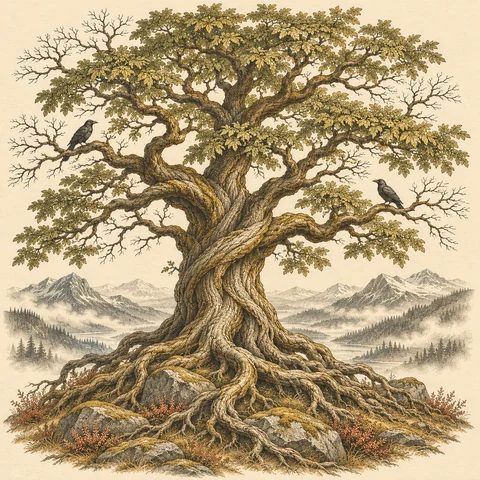
Two brothers and a divine wager
The prose frame of Grímnismál begins with two royal brothers, Agnar and Geirröðr, who are blown away while fishing. An old couple shelters them through the winter. Odin, disguised as the man, fosters the younger Geirröðr; Frigg, disguised as the woman, fosters Agnar. When the brothers return, Geirröðr sends Agnar back out to sea and takes the kingdom after learning that their father has died.
Later Odin boasts of his fosterling’s success. Frigg answers that Geirröðr is so inhospitable that he mistreats guests. The narrator says that this accusation is false. After the gods make a wager, Frigg sends Fulla to warn the king about a dangerous sorcerer whom dogs will refuse to attack. The warning helps create the very situation on which the wager will turn.
Source: The Poetic Edda (1923 translation) · Grímnismál, opening prose frame
A drink for the stranger
Odin arrives wearing a dark cloak and calls himself Grímnir. Geirröðr has him seized and placed between fires to make him reveal more. Eight nights pass. The king’s young son, also named Agnar, brings the prisoner a drink and objects to his father’s treatment of him. This younger Agnar is the displaced brother’s nephew, not the older Agnar returned under another identity.
Grímnir’s long speech begins from the heat and the offered drink, then opens into an account of divine dwellings, animals, rivers, and the world tree. Valhalla appears alongside other halls; Freyja’s share of the slain also has a place. The prisoner’s apparent helplessness gradually becomes an exhibition of extraordinary knowledge. He repeatedly changes the name by which he identifies himself, so that the king has to confront a presence far larger than the anonymous captive he imagined he controlled.
Source: The Poetic Edda (1923 translation) · Grímnismál, opening prose; stanzas 1–3, 8–24, 29–35, 46–50
Recognition comes too late
At the end Odin names himself unmistakably and announces that Geirröðr has lost his favor. The king recognizes him and rises to release him. In the prose conclusion, Geirröðr’s sword slips from his grasp with its hilt downward; he stumbles onto the exposed blade and dies. Odin disappears. The younger Agnar succeeds his father and rules for a long time.
The narrative rewards the boy’s hospitality, but it also exposes how dangerous divine patronage can be. Geirröðr began as Odin’s favored fosterling; Frigg’s deceptive warning steered him toward the offense that destroyed him. The prose frame gives the poem’s catalogues a political and ethical setting, yet it should be distinguished from the spoken verses. This Geirröðr is a human king. He should not be combined with the giant of the same name who attacks Thor in a different narrative.
Source: The Poetic Edda (1923 translation) · Grímnismál 51–54 and concluding prose; compare the opening prose on Frigg’s accusation
- Period / witness
- Medieval Old Norse literature; the Poetic Edda survives chiefly in thirteenth-century copies, and Snorri’s Edda was composed around the 1220s. Mythic events have no historical date.
- Recording context
- Preserved through medieval Icelandic writing and later copies, in a Christian literary culture. Codex Regius of the Poetic Edda dates to c.1270. These recording circumstances do not locate the origin of an oral story.
A recording location is not necessarily a story’s origin. Dates of texts, copies, and translations answer different questions.
Explore time & place →Read the sources
These references support the explanation above. Rights and edition notes are recorded individually.
The Poetic Edda (1923 translation) ↗
Anonymous Old Norse poets; translated by Henry Adams Bellows (1885–1939) · 1923 translation; medieval poems preserved principally in manuscripts of the thirteenth century
Edition & rights note