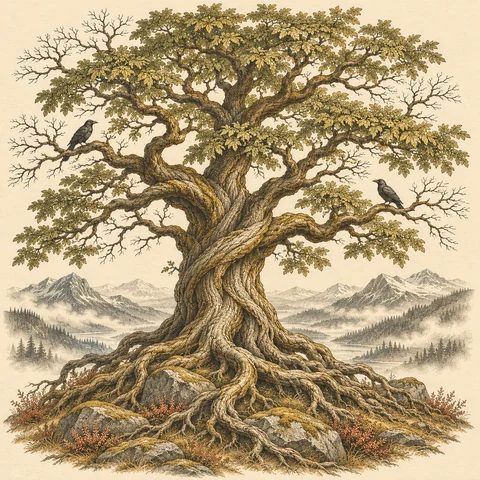
Giving a capacity to human beings
Völuspá names Hœnir with Odin and Lóðurr among the three figures who encounter Ask and Embla. The human pair lacks essential capacities until the gods provide them. Bellows renders Hœnir’s particular contribution as sense; “understanding” conveys the role without pretending that every translator divides the Old Norse terms identically.
This passage does not name Odin’s brothers Vili and Vé as the companions. Those names belong to the different creation arrangement in Gylfaginning. Keeping Hœnir visible therefore changes the actual set of makers in the selected witness. A blended family diagram that removes him would erase an important distinction between the poem and the prose account.
Sources: The Poetic Edda (1923 translation); The Younger Edda / Prose Edda (1901 printing) · Völuspá 17–18; contrast Gylfaginning, chapters IV–V, §§6, 9 in Anderson
The leader who relies on Mímir
Ynglinga saga sends Hœnir to the Vanir in a hostage exchange after war. He is impressive in appearance and is made their leader, but he depends on Mímir’s advice. When Mímir is absent and a difficult decision arises, Hœnir tells others to decide. The Vanir suspect that they have received an inferior exchange and kill Mímir.
The story makes Hœnir’s authority a political problem: appearance and appointment do not supply independent judgment. That characterization should not be allowed to overwrite his creative role in Völuspá. The witnesses use him in different situations, and the saga’s account of failed leadership is not a universal definition of his intelligence.
Source: Ynglinga saga, Finnur Jónsson’s Old Norse edition · Ynglinga saga, chapter 4
A companion and a survivor
Hœnir also accompanies Odin and Loki on the journey that begins Iðunn’s abduction story. He is present when the travelers cannot cook their ox, although Loki makes the fateful bargain with Þjazi. His presence helps identify a recurrent traveling company without giving every member equal responsibility for what follows.
Near Völuspá’s ending, Hœnir appears again in the renewed world in connection with divinatory knowledge. Bellows renders the brief action as receiving a prophetic wand; the compressed wording should not be expanded into an elaborate new institution. From creation to the aftermath of destruction, the poem gives Hœnir a place beyond the better-known hostage episode, while leaving much of his story untold.
Sources: The Younger Edda / Prose Edda (1901 printing); The Poetic Edda (1923 translation) · Skáldskaparmál, “Brage’s Talk,” chapter II, §2 in Anderson; Völuspá 63
- Period / witness
- Medieval Old Norse literature; the Poetic Edda survives chiefly in thirteenth-century copies, and Snorri’s Edda was composed around the 1220s. Mythic events have no historical date.
- Recording context
- Preserved through medieval Icelandic writing and later copies, in a Christian literary culture. Codex Regius of the Poetic Edda dates to c.1270. These recording circumstances do not locate the origin of an oral story.
A recording location is not necessarily a story’s origin. Dates of texts, copies, and translations answer different questions.
Explore time & place →Read the sources
These references support the explanation above. Rights and edition notes are recorded individually.
The Poetic Edda (1923 translation) ↗
Anonymous Old Norse poets; translated by Henry Adams Bellows (1885–1939) · 1923 translation; medieval poems preserved principally in manuscripts of the thirteenth century
Edition & rights noteThe Younger Edda / Prose Edda (1901 printing) ↗
Snorri Sturluson (1179–1241); translated by Rasmus B. Anderson (1846–1936) · 1901 printing of Anderson’s translation (copyright 1879); medieval work composed in Iceland around the 1220s
Edition & rights noteYnglinga saga, Finnur Jónsson’s Old Norse edition ↗
Attributed to Snorri Sturluson (1179–1241); edited by Finnur Jónsson (1858–1934) · Medieval Icelandic work, early thirteenth century; Finnur Jónsson’s Heimskringla I–IV published 1893–1900
Edition & rights note