Music made from an obstruction
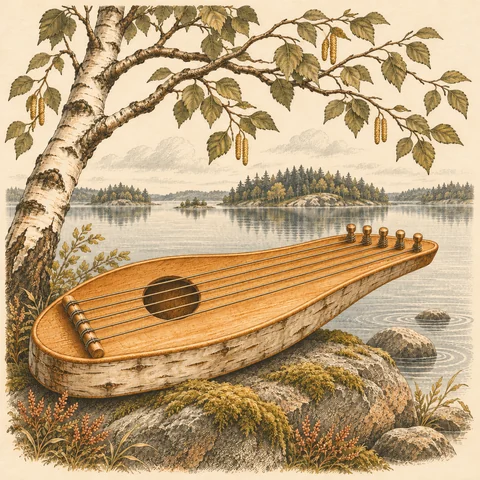
A great pike halts the travelers’ boat. After it is killed, Väinämöinen makes the first kantele from its jaw. Others try without success to play it; the maker’s performance brings beings of air, land, and water together as listeners. Tears and stillness measure the music’s effect.
The instrument’s origin changes an obstacle into a medium of connection. It also shows that making or holding an object does not automatically supply the skill to use it. The performance depends on a particular relationship between player, instrument, and audience.
Source: Kalevala, The Land of the Heroes, Volume Two · Runos XL–XLI
Beauty and control share an instrument
At Pohjola the kantele puts the inhabitants to sleep, enabling the Sampo’s theft. Later it falls into the water and cannot be recovered. Väinämöinen makes another from birchwood and other gathered materials, again drawing listeners.
These uses prevent the instrument from standing only for harmless beauty. Music can move an audience, coordinate a community, or disable resistance. Its replacement also separates art from one irreplaceable object: the first material form is lost, but the capacity for performance continues. At the epic’s end, the departing singer leaves the kantele and songs to those who remain.
Source: Kalevala, The Land of the Heroes, Volume Two · Runos XLII; XLIV; L 475–512
- Period / witness
- Elias Lönnrot’s expanded Kalevala, 1849; W. F. Kirby’s English translation first published 1907. Narrative time is not a historical date.
- Recording context
- A nineteenth-century literary compilation based on Finnish, Karelian, and Ingrian oral poetry. These entries describe the selected compiled epic, not a single unchanged oral text or every living tradition.
A recording location is not necessarily a story’s origin. Dates of texts, copies, and translations answer different questions.
Explore time & place →Read the sources
These references support the explanation above. Rights and edition notes are recorded individually.
Kalevala, The Land of the Heroes, Volume Two ↗
Elias Lönnrot (compiler, 1802–1884); translated by William Forsell Kirby (1844–1912) · Expanded Finnish compilation 1849; English translation first published 1907
Edition & rights note