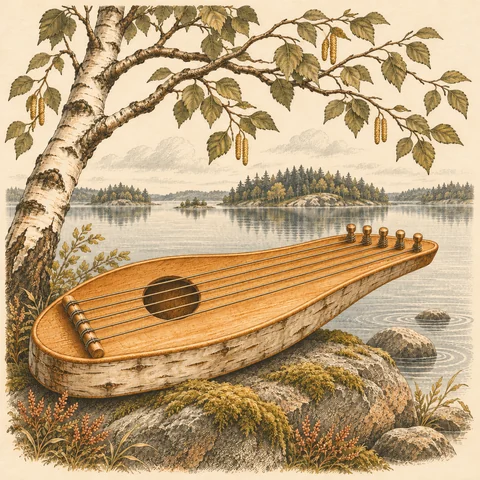
The voyage and its music
Väinämöinen persuades Ilmarinen to travel to Pohjola for the Sampo, and Lemminkäinen joins them. Their boat catches on a great pike. After killing and eating it, Väinämöinen makes a kantele from its jaw. Others cannot play it successfully, but his music draws living beings to listen and moves them to tears.
The instrument later provides a means of power rather than only delight. Arriving at Pohjola, Väinämöinen demands a share of the Sampo or threatens to take it. Louhi refuses. He plays until the inhabitants sleep, allowing the travelers to enter the mountain and remove the treasure.
Source: Kalevala, The Land of the Heroes, Volume Two · Runos XXXIX–XLI; XLII, lines 1–164
The owner wakes and follows
The travelers sail away carrying the Sampo. Noise eventually rouses Pohjola, and Louhi discovers the loss. She sends obstacles against the fugitives, including fog and storm. During the turmoil the kantele falls into the water. She then pursues in a vessel with armed companions.
A battle follows. Louhi assumes an enormous bird form and brings the attackers against the escaping boat. The defenders resist, but the Sampo is torn from its place and falls into the sea, where it breaks. Neither side finishes the struggle holding the intact object it wanted. The means of securing abundance has been destroyed through competing claims to it.
Source: Kalevala, The Land of the Heroes, Volume Two · Runo XLII, lines 165–562; XLIII, lines 1–266
Prosperity survives in fragments
The large pieces remain in the water and contribute to its riches. Smaller fragments reach the shore, where Väinämöinen gathers and plants them in hope of future prosperity. Louhi returns with only a little of the cover and threatens further harm. The ending establishes a changed distribution of benefits, not the restoration of peaceful agreement.
The poem can celebrate the shore’s good fortune while also showing that it comes from a raid and a shattered possession. Calling the expedition an uncomplicated rescue would hide Louhi’s ownership and refusal. Its final image is recovery from breakage: the fragments become productive without making the original treasure whole again.
Source: Kalevala, The Land of the Heroes, Volume Two · Runo XLIII, lines 267–434
- Period / witness
- Elias Lönnrot’s expanded Kalevala, 1849; W. F. Kirby’s English translation first published 1907. Narrative time is not a historical date.
- Recording context
- A nineteenth-century literary compilation based on Finnish, Karelian, and Ingrian oral poetry. These entries describe the selected compiled epic, not a single unchanged oral text or every living tradition.
A recording location is not necessarily a story’s origin. Dates of texts, copies, and translations answer different questions.
Explore time & place →Read the sources
These references support the explanation above. Rights and edition notes are recorded individually.
Kalevala, The Land of the Heroes, Volume Two ↗
Elias Lönnrot (compiler, 1802–1884); translated by William Forsell Kirby (1844–1912) · Expanded Finnish compilation 1849; English translation first published 1907
Edition & rights note