A listener below the surface
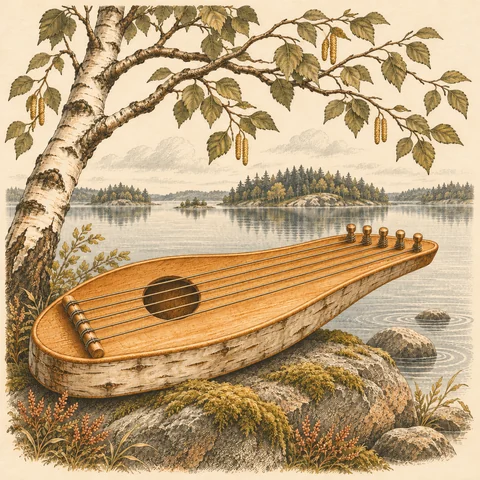
When Väinämöinen plays the first kantele, the audience includes beings associated with water as well as people, birds, and forest animals. Ahto rises to the surface and climbs onto a water-lily to listen. Music crosses an environmental boundary that ordinary speech or movement might not easily cross.
The scene gives the water realm a responsive presence. Its inhabitants are not merely background scenery around a boat. Yet an appearance in the audience does not supply a complete myth of Ahto’s birth, marriage, or rule. Those matters require their own evidence rather than being filled from a generalized modern pantheon.
Source: Kalevala, The Land of the Heroes, Volume Two · Runo XLI, gathering of the water beings within lines 1–168
Similar names, different narrative roles
Kirby’s glossary identifies Ahti as a name of Lemminkäinen and Ahto as the water god; Runo XXVI also calls the hero Ahto Saarelainen. A reader should therefore identify the speaker, setting, and action before deciding whom a name denotes. The traveler who quarrels at Pohjola and the aquatic figure who rises from the waters to listen are not made identical simply by sharing a form of address.
This is a useful example of the compilation’s layered naming practices. The safest account preserves what a passage does rather than forcing every occurrence into one biography. Water’s role in the Sampo cycle further emphasizes the setting: it can carry travelers, conceal a lost instrument, and retain the treasure’s largest fragments without being a neutral empty space.
Source: Kalevala, The Land of the Heroes, Volume Two · Runos XXVI, opening; XLI; XLIII 267–304; glossary entries Ahti and Ahto
- Period / witness
- Elias Lönnrot’s expanded Kalevala, 1849; W. F. Kirby’s English translation first published 1907. Narrative time is not a historical date.
- Recording context
- A nineteenth-century literary compilation based on Finnish, Karelian, and Ingrian oral poetry. These entries describe the selected compiled epic, not a single unchanged oral text or every living tradition.
A recording location is not necessarily a story’s origin. Dates of texts, copies, and translations answer different questions.
Explore time & place →Read the sources
These references support the explanation above. Rights and edition notes are recorded individually.
Kalevala, The Land of the Heroes, Volume Two ↗
Elias Lönnrot (compiler, 1802–1884); translated by William Forsell Kirby (1844–1912) · Expanded Finnish compilation 1849; English translation first published 1907
Edition & rights note