An extraordinary pregnancy meets rejection
Marjatta lives with conspicuous concern for purity. While tending animals she hears a berry calling to be gathered. It rises along her body, enters her mouth, and makes her pregnant. Kirby calls the fruit a cranberry; the event is narrated as an extraordinary conception, not an ordinary encounter she is secretly concealing.
Her family refuses her explanation and denies her a suitable place to give birth. A servant seeks help but returns with an insulting offer of shelter in a stable. Marjatta goes there in pain. A horse’s breath provides warmth, and she gives birth to a boy.
Source: Kalevala, The Land of the Heroes, Volume Two · Runo L, lines 1–346
A child lost and judged
The child later disappears. Marjatta searches and questions beings in the surrounding world until the sun tells her where he lies. She recovers him from the marsh and takes him to an old man for baptism. The officiant will not proceed before the child’s status has been considered.
Väinämöinen is called to judge. He recommends that the child be put to death. The infant answers him, pointing to the injustice of the sentence and recalling the judge’s own troubling actions. A supposedly helpless and voiceless figure therefore exposes the limits of the established singer’s moral authority.
Source: Kalevala, The Land of the Heroes, Volume Two · Runo L, lines 347–474
Departure without the disappearance of song
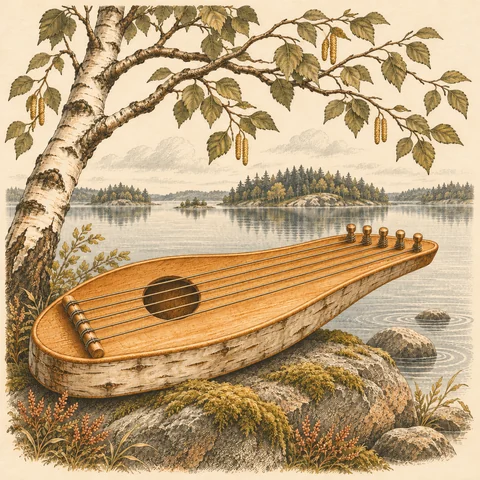
The old man baptizes the boy as ruler of Karelia. Väinämöinen leaves in anger, declaring that people will need him again for a new Sampo, music, and light. He sails away in a copper boat, leaving his kantele and songs behind. The epic’s concluding voice then turns toward the continuation of singing itself.
The episode uses Christian birth and baptismal imagery while retaining the poem’s earlier powers and objects. It is not a dated record of a single national conversion. Within Lönnrot’s compiled ending, authority changes hands, but the departing figure’s art remains available. The old singer is displaced as judge without every song associated with him being erased.
Source: Kalevala, The Land of the Heroes, Volume Two · Runo L, lines 475–620
- Period / witness
- Elias Lönnrot’s expanded Kalevala, 1849; W. F. Kirby’s English translation first published 1907. Narrative time is not a historical date.
- Recording context
- A nineteenth-century literary compilation based on Finnish, Karelian, and Ingrian oral poetry. These entries describe the selected compiled epic, not a single unchanged oral text or every living tradition.
A recording location is not necessarily a story’s origin. Dates of texts, copies, and translations answer different questions.
Explore time & place →Read the sources
These references support the explanation above. Rights and edition notes are recorded individually.
Kalevala, The Land of the Heroes, Volume Two ↗
Elias Lönnrot (compiler, 1802–1884); translated by William Forsell Kirby (1844–1912) · Expanded Finnish compilation 1849; English translation first published 1907
Edition & rights note