An authority who has to learn
Väinämöinen is born from Ilmatar after the world has already taken shape. His mature authority rests especially on song and knowledge of origins. In the contest with Joukahainen, words alter material circumstances and trap the challenger. In boat-building, however, three missing words stop his work and force him to seek another keeper of knowledge.
These episodes distinguish authority from omniscience. He can defeat a boastful rival without possessing everything necessary for his own craft. Vipunen, the healer of his wounded knee, and the animal helpers he encounters all expose different limits to independence.
Source: Kalevala, The Land of the Heroes, Volume One · Runos I 281–344; III 271–476; IX; XVI–XVII
A singer whose judgments can fail
Aino’s story makes his courtship difficult to celebrate, since her own wishes resist the agreement made by her brother. At the epic’s end, Marjatta’s infant directly challenges Väinämöinen’s harsh judgment. These are not merely interruptions to a uniformly wise biography.
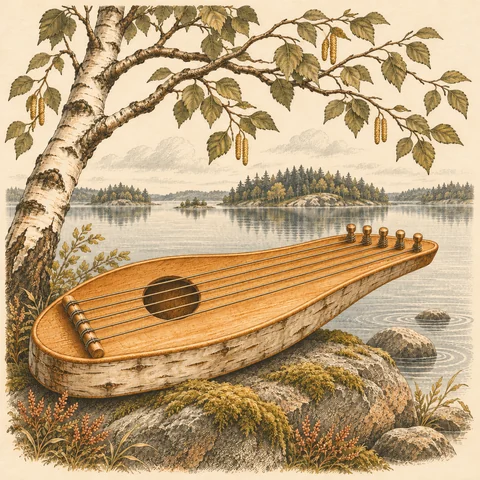
His music nevertheless remains valuable. The kantele gathers listeners across species, and he leaves song behind when he departs. The compiled character combines creative authority with possessiveness, error, and learning. An article confined to the label “god of music” would miss the narrative tensions through which that authority is repeatedly tested.
Sources: Kalevala, The Land of the Heroes, Volume One; Kalevala, The Land of the Heroes, Volume Two · Runos IV–V; XLI; L 431–620
- Period / witness
- Elias Lönnrot’s expanded Kalevala, 1849; W. F. Kirby’s English translation first published 1907. Narrative time is not a historical date.
- Recording context
- A nineteenth-century literary compilation based on Finnish, Karelian, and Ingrian oral poetry. These entries describe the selected compiled epic, not a single unchanged oral text or every living tradition.
A recording location is not necessarily a story’s origin. Dates of texts, copies, and translations answer different questions.
Explore time & place →Read the sources
These references support the explanation above. Rights and edition notes are recorded individually.
Kalevala, The Land of the Heroes, Volume One ↗
Elias Lönnrot (compiler, 1802–1884); translated by William Forsell Kirby (1844–1912) · Expanded Finnish compilation 1849; translation first published 1907; digitized printing lists reprints through 1936
Edition & rights noteKalevala, The Land of the Heroes, Volume Two ↗
Elias Lönnrot (compiler, 1802–1884); translated by William Forsell Kirby (1844–1912) · Expanded Finnish compilation 1849; English translation first published 1907
Edition & rights note