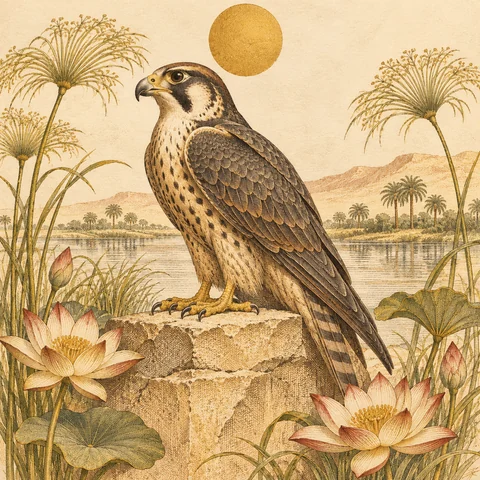
A presence in the blessed fields
The Bennu appears among the images associated with the deceased’s flourishing afterlife. In the agricultural vignettes discussed by Budge, Nebseni encounters the bird on a stand, while Ani addresses or venerates it among scenes of reaping, ploughing, provisions, and waterways. The placement gives the bird a setting of sustained life. It is not simply an isolated emblem to be detached from the person, crops, offerings, and divine beings surrounding it. This cluster of actions connects renewal with participation in a well-provisioned world, rather than only with an extraordinary animal’s private life cycle.
Source: Egyptian Ideas of the Future Life · Chapter V, numbered descriptions of Book of the Dead 110 vignettes of Nebseni, item 7, and Ani, item 2
Purity and protection
In the declarations associated with Book of the Dead 125, the speaker likens personal purity to that of the great Bennu. On the Metternich Stela, Horus is identified with the divine bird as part of the effort to drive out poison. These uses make the Bennu a resource for asserting a person’s or god’s desired condition. They are not all episodes in a single sequential biography. The funerary speaker seeks fitness for divine company; the healing text seeks the threatened child’s survival. The same powerful image can support both purposes without making the two rituals identical.
Sources: Egyptian Ideas of the Future Life; Legends of the Gods: The Egyptian Texts, edited with Translations · Budge Future Life IV, opening purity declaration of Book of the Dead 125; Legends VIII, protective addresses to Horus and Thoth’s litany
The limits of “Egyptian phoenix”
Calling the Bennu an Egyptian phoenix can provide a quick point of recognition, but it also brings expectations that these passages do not supply. Neither the agricultural scene nor the cited healing invocation tells a complete story about a bird constructing a pyre and rising from its ashes. That familiar image should not be inserted as if it were present in every Egyptian reference. Here the secure emphasis is renewed and protected existence. Following the actual uses of the bird lets us see how a recognizable divine form could connect the deceased, the sun’s world, and an endangered child.
Sources: Egyptian Ideas of the Future Life; Legends of the Gods: The Egyptian Texts, edited with Translations · Book of the Dead 110 and 125 passages cited above; Legends VIII, Bennu references
- Period / witness
- Selected New Kingdom funerary witnesses and fourth-century BCE healing inscription.
- Recording context
- Book of the Dead 110 and 125 as discussed through the papyri of Ani and Nebseni; Metternich Stela, Met 50.85.
A recording location is not necessarily a story’s origin. Dates of texts, copies, and translations answer different questions.
Explore time & place →Read the sources
These references support the explanation above. Rights and edition notes are recorded individually.
Egyptian Ideas of the Future Life ↗
E. A. Wallis Budge · 1899; third edition 1908; ebook updated 2024
Edition & rights noteLegends of the Gods: The Egyptian Texts, edited with Translations ↗
E. A. Wallis Budge (1857–1934) · 1912; digital edition updated 2021
Edition & rights note