A mobile aspect of the person
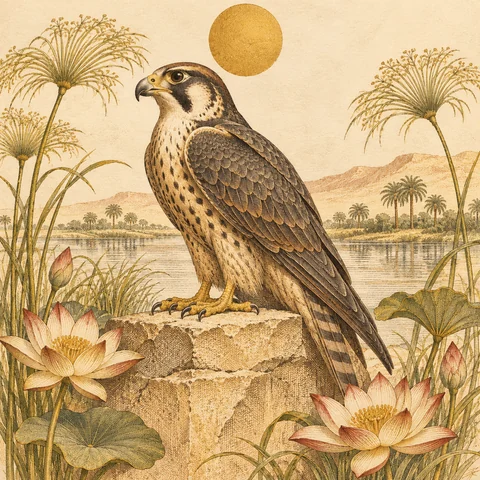
The ba is often translated as soul, but that familiar English word carries assumptions that do not fit every Egyptian passage. The Met’s scarab shows a long-necked bird alongside the sign for goodness or beauty, forming a wish for the ba’s well-being. Other representations give the bird a human head. Mobility is important: the image allows personal identity to be imagined as capable of leaving the tomb rather than remaining fixed within it. This is one aspect of a larger vocabulary of embodied and continuing existence, not a complete replacement for the body or for all the person’s other dimensions.
Source: Scarab with Ba bird and nefer, 04.2.327 · Met 04.2.327, bird identification, nefer sign, and interpretation of the ba
A partner in a difficult conversation
The Middle Kingdom Dialogue of a man with his ba gives the ba a speaking role. Its surviving papyrus lacks the beginning, and the relationship between the speakers has produced difficult questions of interpretation. The man and his ba debate the value of life, death, and the future rather than serving as a simple illustration of a dictionary definition. UCL describes the ba as encouraging the man toward life’s pleasures. The literary exchange shows that an aspect of identity can be made into an interlocutor, allowing a text to explore disagreement within a person through dramatic conversation.
Source: Egyptian Literary Compositions: Tales at the court of king Khufu · Middle Egyptian literary summaries, “Dialogue of a man with his soul,” Papyrus Berlin 3024
Divine bas and human hopes
Book of the Dead 17 also speaks of divine souls, bringing Ra and Osiris together and offering further identifications involving Shu and Tefnut. The term therefore does not belong exclusively to individual human psychology. In a funerary setting, such divine relationships help the speaker claim participation in a world of transformation and continuity. The papyrus of Gautsoshen similarly seeks freedom to emerge from the hidden realm. Taken together, these witnesses encourage a careful reading: the ba concerns identity and movement, but each narrative, caption, or spell determines whose identity is in view and what kind of movement is being sought.
Sources: Book of the Dead Chapter 17; Amduat papyrus inscribed for Gautsoshen, 25.3.31 · Book of the Dead 17a.14; Met 25.3.31, central inscription seeking open gates and emergence
- Period / witness
- Selected Middle Kingdom literary manuscript and New Kingdom to Late Period funerary witnesses.
- Recording context
- Dialogue of a man with his ba, Berlin 3024; Met scarab 04.2.327, ca. 721–525 BCE; Book of the Dead 17 in multiple papyri.
A recording location is not necessarily a story’s origin. Dates of texts, copies, and translations answer different questions.
Explore time & place →Read the sources
These references support the explanation above. Rights and edition notes are recorded individually.
Scarab with Ba bird and nefer, 04.2.327 ↗
Department of Egyptian Art · Object ca. 721–525 BCE; undated catalogue page
Edition & rights noteEgyptian Literary Compositions: Tales at the court of king Khufu ↗
Digital Egypt for Universities · Undated educational page; consulted 2026
Edition & rights noteBook of the Dead Chapter 17 ↗
Digital Egypt for Universities; text after Naville, sections after T. G. Allen · Modern educational edition following Allen 1974; undated page
Edition & rights noteAmduat papyrus inscribed for Gautsoshen, 25.3.31 ↗
Department of Egyptian Art · Object ca. 1000–945 BCE; undated catalogue page
Edition & rights note