Advice fitted to the occasion
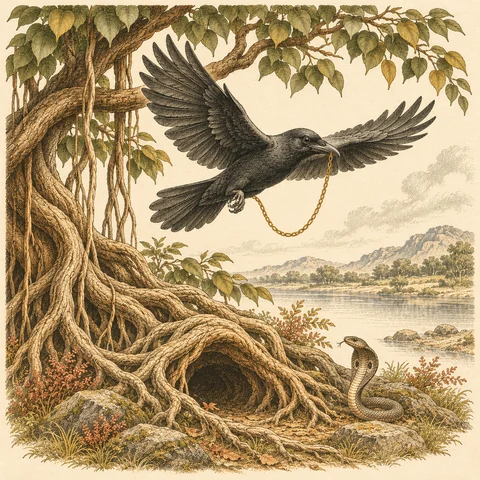
After Cloudy hears several counselors propose responses to the owl attacks, he consults the experienced Live-Strong. The old crow does not dismiss every earlier proposal as inherently foolish; he argues that circumstances now require deception. He connects useful policy to knowledge of the enemy’s residence and weaknesses. The problem is practical: the crows are vulnerable at night, and their opponents’ daytime hiding place remains unknown. Winning requires information before an attack can be arranged.
Source: Panchatantra, Book 3: Crows and Owls · Book III, Crows and Owls, opening council and Live-Strong’s advice
An injury performed for observers
Live-Strong devises a quarrel in which Cloudy pretends to punish him, smears him with supplied blood, and leaves him behind while the crows withdraw. The apparent victim tells the owls that he was attacked for advising peace and offers to help destroy his former companions. Most owl counselors accept him; Red-Eye alone persists in opposition. Live-Strong then requests lodging at the fortress entrance, where his movements can serve his plan without exposing him to constant observation inside.
Source: Panchatantra, Book 3: Crows and Owls · Book III, frame after The Snake and the Ants and following Mouse-Maid Made Mouse
The purpose of the nest
At the gate, Live-Strong collects wood under the appearance of building a nest. After Red-Eye and his followers leave, he summons Cloudy’s crows, each carrying fire, to ignite the accumulation while the owls are confined by daylight. His successful counsel ends in mass killing, not reconciliation. The entry follows the narrative’s political argument while keeping its violence visible. The old counselor’s effectiveness does not make him an uncomplicated model of kindness or turn the owl victims into imaginary obstacles.
Source: Panchatantra, Book 3: Crows and Owls · Book III, frame after The Cave That Talked: preparation, burning, and return to the banyan
- Period / witness
- Purnabhadra recension dated 1199 CE; Arthur W. Ryder translation published 1925. These dates identify textual witnesses, not the first telling of every episode.
- Recording context
- Panchatantra in Arthur W. Ryder’s 1925 English translation of the Purnabhadra recension; passages are identified by book, named tale, and the surrounding frame narrative.
A recording location is not necessarily a story’s origin. Dates of texts, copies, and translations answer different questions.
Explore time & place →Read the sources
These references support the explanation above. Rights and edition notes are recorded individually.
Panchatantra, Book 3: Crows and Owls ↗
Pūrṇabhadra recension (1199 CE); English translation by Arthur W. Ryder (1877–1938), based on Johannes Hertel’s Sanskrit edition · Pūrṇabhadra recension 1199 CE; Hertel edition 1908; Ryder translation 1925
Edition & rights note