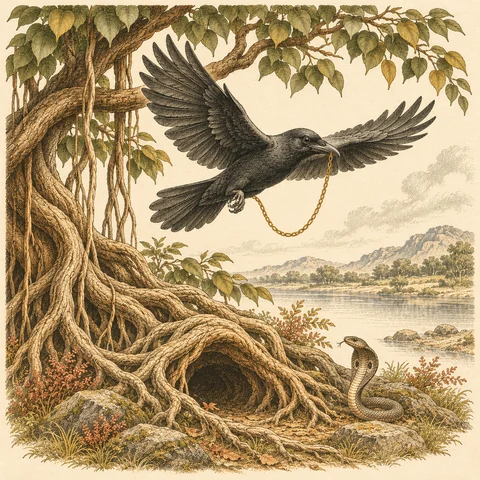
A kingdom under repeated attack
Cloudy rules crows in a great banyan near Earth-Base. Foe-Crusher’s owls attack at night, leaving the crows unable to defend themselves effectively or find their attackers’ refuge. Cloudy convenes counselors and asks about several possible policies, including peace, war, retreat, alliance, and deception. The opening presents sovereignty as a problem of choosing among competing proposals. Having many followers does not remove the need to discover when and where their collective force could be useful.
Source: Panchatantra, Book 3: Crows and Owls · Book III, Crows and Owls, opening frame and council
The ruler as actor
Having heard Live-Strong’s plan, Cloudy participates in a public sham quarrel. His followers nearly interfere because they do not understand the performance, but he takes responsibility for punishing the supposed traitor. He pecks lightly, applies prepared blood, and leads the flock to Antelope Mountain. The apparent breakdown of authority is a coordinated act. Its success depends both on deceiving enemy observers and on preventing his own indignant subjects from turning the invented punishment into an actual killing.
Source: Panchatantra, Book 3: Crows and Owls · Book III, frame after The Snake and the Ants: staged quarrel and withdrawal
Acting before hearing the whole story
When Live-Strong returns, Cloudy first wants an account of his adventures. The counselor insists that the attack cannot wait: discovery could allow the owls to escape. Cloudy follows the advice, and his crows carry burning wood to the prepared fortress gate. Only afterward do explanation and celebration occur. The narrative thus contrasts useful deliberation before a strategy is chosen with dangerous delay once an opportunity exists. It also makes the king responsible for the destructive outcome his counselor has arranged.
Source: Panchatantra, Book 3: Crows and Owls · Book III, frame after The Cave That Talked: burning of the owl fortress and subsequent discussion
- Period / witness
- Purnabhadra recension dated 1199 CE; Arthur W. Ryder translation published 1925. These dates identify textual witnesses, not the first telling of every episode.
- Recording context
- Panchatantra in Arthur W. Ryder’s 1925 English translation of the Purnabhadra recension; passages are identified by book, named tale, and the surrounding frame narrative.
A recording location is not necessarily a story’s origin. Dates of texts, copies, and translations answer different questions.
Explore time & place →Read the sources
These references support the explanation above. Rights and edition notes are recorded individually.
Panchatantra, Book 3: Crows and Owls ↗
Pūrṇabhadra recension (1199 CE); English translation by Arthur W. Ryder (1877–1938), based on Johannes Hertel’s Sanskrit edition · Pūrṇabhadra recension 1199 CE; Hertel edition 1908; Ryder translation 1925
Edition & rights note