Advice the court rejects
Red-Eye is the first owl counselor asked what should be done with the injured-looking Live-Strong. He recommends killing him while he is vulnerable, rejecting the assumption that an enemy’s apparent misfortune makes him safe. Other ministers tell stories in favor of protection or useful cooperation, and the king takes their side. Red-Eye’s position is harsh, but within this plot it accurately recognizes a continuing hostile intention concealed beneath a request for refuge.
Source: Panchatantra, Book 3: Crows and Owls · Book III, owl council following Live-Strong’s discovery; The Snake who Paid Cash
Testing a performance
Live-Strong offers further theatrical evidence of loyalty, even proposing fire and rebirth as an owl. Red-Eye refuses to take this as proof of changed allegiance and answers with Mouse-Maid Made Mouse. Later, the king’s lavish care of the crow prompts another warning through The Bird With Golden Dung. The counselor’s repeated storytelling is an effort to change a consequential decision. Its failure shows that having an apt comparison available does not ensure that rulers will use it.
Source: Panchatantra, Book 3: Crows and Owls · Book III, frame around Mouse-Maid Made Mouse and The Bird With Golden Dung
Leaving with his own followers
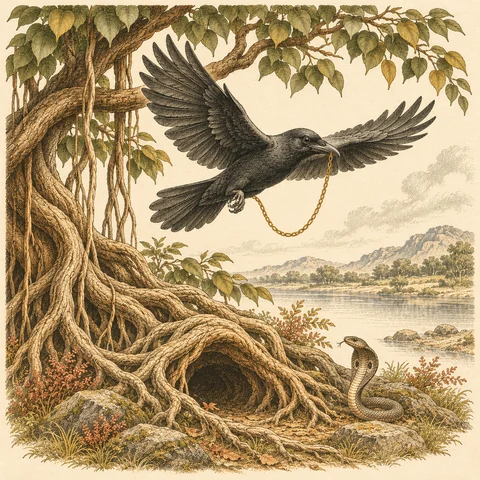
Finally Red-Eye gathers his adherents and tells The Cave That Talked, in which a jackal escapes by recognizing danger outside a supposed refuge. He then leads them to another mountain fortress. Live-Strong explicitly welcomes the departure of the one opponent who understood him. The remaining owls are burned, but Red-Eye’s party has already left. Their survival complicates any summary that says every owl dies or that the story permits dissent only as a useless final warning.
Source: Panchatantra, Book 3: Crows and Owls · Book III, The Cave That Talked and immediately following frame
- Period / witness
- Purnabhadra recension dated 1199 CE; Arthur W. Ryder translation published 1925. These dates identify textual witnesses, not the first telling of every episode.
- Recording context
- Panchatantra in Arthur W. Ryder’s 1925 English translation of the Purnabhadra recension; passages are identified by book, named tale, and the surrounding frame narrative.
A recording location is not necessarily a story’s origin. Dates of texts, copies, and translations answer different questions.
Explore time & place →Read the sources
These references support the explanation above. Rights and edition notes are recorded individually.
Panchatantra, Book 3: Crows and Owls ↗
Pūrṇabhadra recension (1199 CE); English translation by Arthur W. Ryder (1877–1938), based on Johannes Hertel’s Sanskrit edition · Pūrṇabhadra recension 1199 CE; Hertel edition 1908; Ryder translation 1925
Edition & rights note