Power with a daily limit
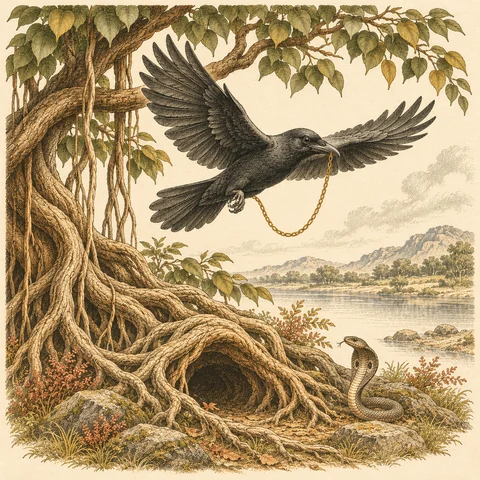
Foe-Crusher’s owls inhabit a mountain cave and repeatedly strike Cloudy’s crows at night. Their nocturnal advantage is decisive at first, but the narrative couples it with inability to see in daylight. The fortress protects them only while its location and entrance remain secure. This specific arrangement of time and place drives the plot. The owls are characters in a political fable, and their limitations should not be treated as a complete account of real owl behavior.
Source: Panchatantra, Book 3: Crows and Owls · Book III, Crows and Owls, opening frame
A council that chooses badly
After the crows abandon their tree, Foe-Crusher discovers the apparently wounded Live-Strong. He hears the crow’s claim of punishment for advocating peace, then consults five ministers. Red-Eye recommends killing the enemy immediately; others support sparing him through arguments and stories. The king accepts the welcoming policy and provides excellent food. The failure lies not in having no advice available, but in judging which counsel fits a visitor whose story serves a concealed purpose.
Source: Panchatantra, Book 3: Crows and Owls · Book III, frame from Live-Strong’s discovery through the owl counselors’ debate
Generosity without scrutiny
Foe-Crusher offers Live-Strong a choice of rooms. The crow instead requests the gate, where he can accumulate wood without attracting adequate suspicion. Red-Eye leaves after repeated warnings are ignored. When the crows return with fire at sunrise, the owls remain trapped in the cave and die. The generous treatment of one supposed ally becomes disastrous for the ruler’s own dependents. This account stages a severe warning about misplaced trust; it does not establish that compassion necessarily produces failure in every Panchatantra story.
Source: Panchatantra, Book 3: Crows and Owls · Book III, frame after Mouse-Maid Made Mouse, The Bird With Golden Dung, and The Cave That Talked
- Period / witness
- Purnabhadra recension dated 1199 CE; Arthur W. Ryder translation published 1925. These dates identify textual witnesses, not the first telling of every episode.
- Recording context
- Panchatantra in Arthur W. Ryder’s 1925 English translation of the Purnabhadra recension; passages are identified by book, named tale, and the surrounding frame narrative.
A recording location is not necessarily a story’s origin. Dates of texts, copies, and translations answer different questions.
Explore time & place →Read the sources
These references support the explanation above. Rights and edition notes are recorded individually.
Panchatantra, Book 3: Crows and Owls ↗
Pūrṇabhadra recension (1199 CE); English translation by Arthur W. Ryder (1877–1938), based on Johannes Hertel’s Sanskrit edition · Pūrṇabhadra recension 1199 CE; Hertel edition 1908; Ryder translation 1925
Edition & rights note