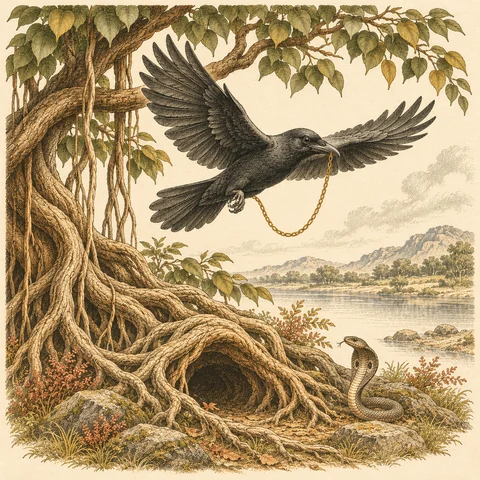
An insult with consequences
Strong-Tooth manages both royal business and the affairs of his city with unusual success. During his daughter’s wedding celebrations, however, he finds Bull, a palace sweeper, occupying a seat he considers inappropriate. He strikes the servant and drives him away. Bull cannot challenge the merchant’s standing openly, but his work gives him access to the king in private.
While sweeping beside the half-awake ruler, Bull mutters that Strong-Tooth has kissed the queen. When challenged, he claims that a sleepless night of gambling has left him talking without knowing what he says. The king treats the supposed accident as evidence of a concealed affair and bars Strong-Tooth from court.
Source: Panchatantra, Book 1: The Loss of Friends · Panchatantra, Book 1, Merchant Strong-Tooth, pp. 49–57
The rumor turns back
The merchant initially cannot explain his sudden disgrace. Bull’s mocking remarks at the palace gate reveal the source of the trouble. Strong-Tooth invites him home, gives him garments, and explains the earlier humiliation. Gratified by this recognition, the sweeper promises to restore the king’s favor.
The next morning Bull again speaks as if half asleep, this time attributing to the king the absurd habit of eating a cucumber while relieving himself. The ruler knows that claim is false. Recognizing that apparently unconscious speech can contain nonsense, he reconsiders the accusation against Strong-Tooth. He summons the merchant, presents gifts, and reinstates him; neglected administration can resume.
Source: Panchatantra, Book 1: The Loss of Friends · Panchatantra, Book 1, Merchant Strong-Tooth, pp. 49–57
Who controls access to belief?
The reversal depends on the king testing a rumor against something he knows about himself. He never performs an equivalent investigation of the queen’s conduct. Suspicion first substitutes for evidence, while a second falsehood supplies the correction.
Within the surrounding lion-and-bull narrative, Victor tells this story to emphasize the influence of royal attendants. Its lesson is therefore interested advice about managing a court, not simply an instruction to be generous. Strong-Tooth’s office gives him formal authority, but Bull’s proximity gives him another kind of power. The tale exposes both the cost of humiliating a subordinate and the vulnerability of a ruler who mistakes insinuation for knowledge.
Source: Panchatantra, Book 1: The Loss of Friends · Panchatantra, Book 1, Merchant Strong-Tooth, pp. 49–57
- Period / witness
- Pūrṇabhadra recension dated 1199 CE; Arthur W. Ryder translation, 1925. The tales have differing earlier histories.
- Recording context
- Original synopsis and commentary on Ryder’s translation of the Pūrṇabhadra recension, edited by Johannes Hertel. This selected literary witness does not represent all Indian traditions.
A recording location is not necessarily a story’s origin. Dates of texts, copies, and translations answer different questions.
Explore time & place →Read the sources
These references support the explanation above. Rights and edition notes are recorded individually.
Panchatantra, Book 1: The Loss of Friends ↗
Pūrṇabhadra recension (1199 CE); English translation by Arthur W. Ryder (1877–1938), based on Johannes Hertel’s Sanskrit edition · Pūrṇabhadra recension 1199 CE; Hertel edition 1908; Ryder translation 1925
Edition & rights note