An opening at court
Victor and Cheek are sons of counselors who no longer hold office. When Rusty stops short of the river, Victor interprets the lion’s behavior as fear and decides that useful intervention can restore his position. Cheek initially recommends restraint. Victor proceeds, learns that the frightening sound comes from a bull, and recognizes that controlling this information gives him influence over both animals. His first resource is neither force nor a magical object, but unequal access to knowledge.
Source: Panchatantra, Book 1: The Loss of Friends · Book I, The Loss of Friends, opening frame through The Jackal and the War-Drum
The intermediary becomes dispensable
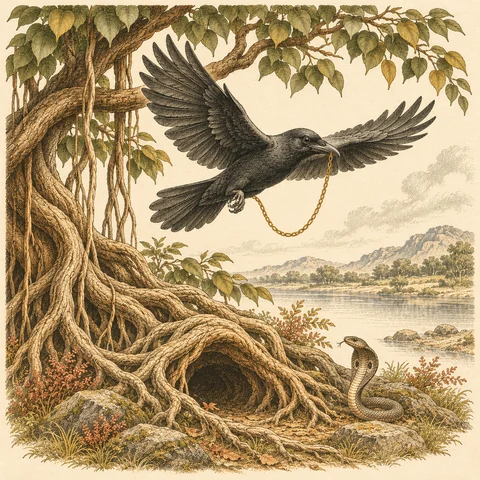
Victor secures an introduction between Rusty and Lively, claiming special religious connections for the bull while arranging protection for him. The resulting friendship soon excludes the jackals. Hunger and lost access turn Victor against the association he helped establish. His many embedded stories defend the effectiveness of stratagem, including the crow-hen’s use of a stolen chain against a snake. Their persuasive function belongs to this ambitious speaker; they are not automatically an impartial authorial endorsement of every deception.
Source: Panchatantra, Book 1: The Loss of Friends · Book I, frame surrounding Merchant Strong-Tooth and How the Crow-Hen Killed the Black Snake
Creating his own confirmation
Victor separately warns lion and bull that the other plans violence, then identifies defensive body language as proof of hostile intention. The frightened animals supply that apparent proof themselves. After Rusty kills Lively, Victor discourages remorse by invoking the special demands of kingship. Cheek answers with an opposing account of responsible counsel. In this selected recension, the book ends with that criticism, rather than a trial and execution of Victor. Other textual continuations should not be silently imported.
Source: Panchatantra, Book 1: The Loss of Friends · Book I, frame after The Blue Jackal; frame after The Plover Who Fought the Ocean; concluding exchange
- Period / witness
- Purnabhadra recension dated 1199 CE; Arthur W. Ryder translation published 1925. These dates identify textual witnesses, not the first telling of every episode.
- Recording context
- Panchatantra in Arthur W. Ryder’s 1925 English translation of the Purnabhadra recension; passages are identified by book, named tale, and the surrounding frame narrative.
A recording location is not necessarily a story’s origin. Dates of texts, copies, and translations answer different questions.
Explore time & place →Read the sources
These references support the explanation above. Rights and edition notes are recorded individually.
Panchatantra, Book 1: The Loss of Friends ↗
Pūrṇabhadra recension (1199 CE); English translation by Arthur W. Ryder (1877–1938), based on Johannes Hertel’s Sanskrit edition · Pūrṇabhadra recension 1199 CE; Hertel edition 1908; Ryder translation 1925
Edition & rights note