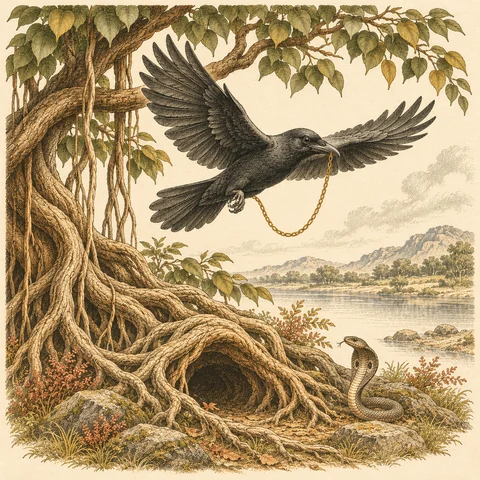
Caution before intervention
Cheek shares Victor’s insecure position as a counselor’s son without current employment. He initially questions why they should interfere in Rusty’s unexplained behavior. His warning story about the wedge-pulling monkey treats meddling as a practical danger, not a universal prohibition on public service. He and Victor debate the opportunities and hazards of approaching a ruler. These disagreements establish him as an interlocutor with his own judgment, rather than merely a silent companion to the more active jackal.
Source: Panchatantra, Book 1: The Loss of Friends · Book I, opening frame and The Wedge-Pulling Monkey
A witness to the consequences
Cheek also suffers when Rusty’s friendship with Lively cuts the court off from food and favor. Nevertheless, once Victor’s intrigue produces combat, Cheek condemns the result. The lion has been exposed to the bull’s horns and the forest thrown into disorder. Success cannot be measured simply by whether two friends have become enemies. His criticism identifies the counselor’s proper task as resolving dangerous conflict while protecting the ruler, rather than exploiting every opportunity for personal advancement.
Source: Panchatantra, Book 1: The Loss of Friends · Book I, frame after Lively’s admission and battle frame before The Unteachable Monkey
Stories as an argument against misuse
Cheek tells the iron balance-beam episode while criticizing Victor’s inability to tolerate another favorite. At the book’s close, he insists that Rusty compare advice, consider consequences, and remain responsible for his own decision. He does not deny that appearances mislead; he argues that this uncertainty demands more careful judgment. His presence prevents the first book from having only one political voice. Readers encounter opposed uses of intelligence inside the same narrative, with Lively’s death giving their disagreement irreversible weight.
Source: Panchatantra, Book 1: The Loss of Friends · Book I, The Mice That Ate Iron and concluding frame after The Foolish Friend
- Period / witness
- Purnabhadra recension dated 1199 CE; Arthur W. Ryder translation published 1925. These dates identify textual witnesses, not the first telling of every episode.
- Recording context
- Panchatantra in Arthur W. Ryder’s 1925 English translation of the Purnabhadra recension; passages are identified by book, named tale, and the surrounding frame narrative.
A recording location is not necessarily a story’s origin. Dates of texts, copies, and translations answer different questions.
Explore time & place →Read the sources
These references support the explanation above. Rights and edition notes are recorded individually.
Panchatantra, Book 1: The Loss of Friends ↗
Pūrṇabhadra recension (1199 CE); English translation by Arthur W. Ryder (1877–1938), based on Johannes Hertel’s Sanskrit edition · Pūrṇabhadra recension 1199 CE; Hertel edition 1908; Ryder translation 1925
Edition & rights note