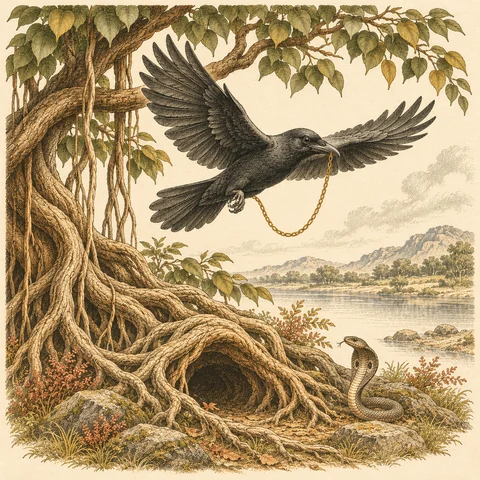
A shared fund with an unequal purpose
Two merchants travel together to improve their fortunes. Right-Mind discovers a pot of money, and on returning home offers his companion half. Wrong-Mind proposes that they keep most of it buried as a joint reserve, withdrawing only limited amounts. Right-Mind accepts this arrangement as an expression of continuing friendship.
After spending his shares, Wrong-Mind secretly removes the remaining money. He then proposes another visit to the hiding place and makes a public display of shock when the pot proves empty. Accusing Right-Mind of theft, he takes the dispute before judges. The friendship that justified keeping a common fund has become the means of manufacturing an accusation.
Source: Panchatantra, Book 1: The Loss of Friends · Panchatantra, Book 1, Right-Mind and Wrong-Mind, including continuation after A Remedy Worse Than the Disease, pp. 184–192
The witness concealed in the trunk
When an ordeal is proposed, Wrong-Mind argues that testimony should take precedence and offers the goddess of the wood as a witness. He then tells his father to hide inside a hollow tree and speak in the goddess’s place. The father warns him through another story that a scheme must be judged by its wider consequences, but participates nevertheless.
At the hearing in the forest, the hidden man declares Right-Mind guilty. The officials begin considering punishment. Right-Mind instead piles combustible material around the opening and sets it alight. The supposed supernatural witness emerges from the smoke, badly scorched, and identifies his son as the author of the deception.
Source: Panchatantra, Book 1: The Loss of Friends · Panchatantra, Book 1, Right-Mind and Wrong-Mind, including continuation after A Remedy Worse Than the Disease, pp. 184–192
A judgment and its cost
The judges execute Wrong-Mind by hanging him from the tree and reward Right-Mind. The narrative gives the wronged partner vindication, but the method of exposure injures the father who helped construct the false evidence. These severe outcomes should remain visible alongside the familiar clever-detection motif.
The tree becomes persuasive because those listening already accept that a divine witness outranks ordinary testimony. Right-Mind changes the question from whether the voice sounds authoritative to where it physically comes from. In the surrounding argument, Cheek uses the episode against Victor’s destructive scheming. The tale shows that elaborate planning can endanger one’s own household, especially when an accomplice’s warning is ignored after his cooperation has been obtained.
Source: Panchatantra, Book 1: The Loss of Friends · Panchatantra, Book 1, Right-Mind and Wrong-Mind, including continuation after A Remedy Worse Than the Disease, pp. 184–192
- Period / witness
- Pūrṇabhadra recension dated 1199 CE; Arthur W. Ryder translation, 1925. The tales have differing earlier histories.
- Recording context
- Original synopsis and commentary on Ryder’s translation of the Pūrṇabhadra recension, edited by Johannes Hertel. This selected literary witness does not represent all Indian traditions.
A recording location is not necessarily a story’s origin. Dates of texts, copies, and translations answer different questions.
Explore time & place →Read the sources
These references support the explanation above. Rights and edition notes are recorded individually.
Panchatantra, Book 1: The Loss of Friends ↗
Pūrṇabhadra recension (1199 CE); English translation by Arthur W. Ryder (1877–1938), based on Johannes Hertel’s Sanskrit edition · Pūrṇabhadra recension 1199 CE; Hertel edition 1908; Ryder translation 1925
Edition & rights note