A refuge and a listener
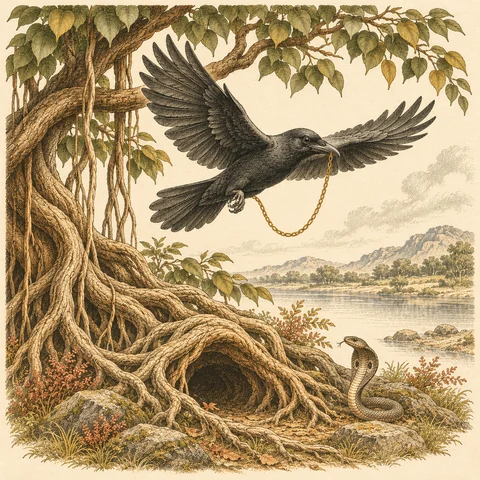
Slow lives in a forest lake and already knows Swift when the crow arrives carrying Gold. The unfamiliar sight first sends the turtle into the water; recognition brings him back to welcome his old friend. He listens to Gold’s account of lost wealth and answers with reflections and stories about earning, possession, and contentment. Hospitality here includes the time given to another creature’s distress. The lake becomes a place for sustained discussion as well as food and shelter.
Source: Panchatantra, Book 2: The Winning of Friends · Book II, frame before Gold’s Gloom and Slow’s response through Soft, the Weaver
Opening the circle
When the frightened deer Spot arrives, Slow welcomes him to drink and bathe. He initially doubts whether small animals can offer a large new friend useful assistance, but Spot rejects that measure of worth. The resulting companionship rests on learning and affection as well as practical help. Slow’s hesitation matters because the story later demonstrates how mistaken a simple ranking by bodily size would be: the mouse’s teeth and crow’s flight will become essential to the deer.
Source: Panchatantra, Book 2: The Winning of Friends · Book II, frame introducing Spot before The Mice That Set Elephants Free
Care without a safe retreat
Slow leaves his lake when he fears for the trapped Spot. Gold immediately recognizes the difficulty: the others can run, fly, or hide when the hunter returns, but the turtle cannot escape as readily on land. The hunter consequently captures him after losing the deer. Gold’s counterplan draws the man away with an apparently dead Spot, allowing Slow’s bonds to be cut beside water. His affection is honored, while its practical danger remains fully visible.
Source: Panchatantra, Book 2: The Winning of Friends · Book II, frame after Spot’s Captivity and the final rescue of Slow
- Period / witness
- Purnabhadra recension dated 1199 CE; Arthur W. Ryder translation published 1925. These dates identify textual witnesses, not the first telling of every episode.
- Recording context
- Panchatantra in Arthur W. Ryder’s 1925 English translation of the Purnabhadra recension; passages are identified by book, named tale, and the surrounding frame narrative.
A recording location is not necessarily a story’s origin. Dates of texts, copies, and translations answer different questions.
Explore time & place →Read the sources
These references support the explanation above. Rights and edition notes are recorded individually.
Panchatantra, Book 2: The Winning of Friends ↗
Pūrṇabhadra recension (1199 CE); English translation by Arthur W. Ryder (1877–1938), based on Johannes Hertel’s Sanskrit edition · Pūrṇabhadra recension 1199 CE; Hertel edition 1908; Ryder translation 1925
Edition & rights note