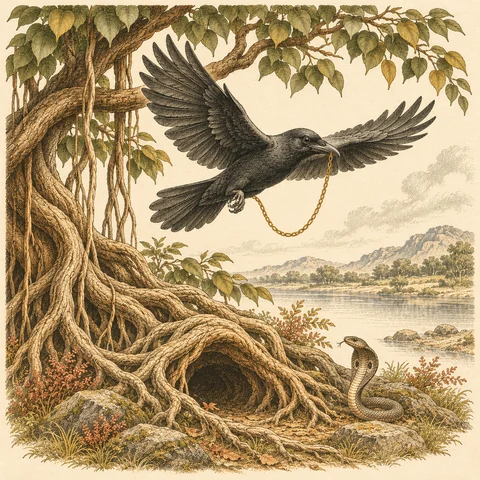
Following an unexpected escape
Swift first notices a hunter approaching his tree and warns its resident birds away from scattered grain. Gay-Neck’s visiting flock is trapped, but carries the net into the air together. Swift follows because he wants to know how their situation will end. He witnesses Gold cutting them free and decides to seek the mouse’s friendship. Curiosity is productive here: he learns from a rescue in which he was an observer rather than the central hero.
Source: Panchatantra, Book 2: The Winning of Friends · Book II, opening frame through the release of Gay-Neck’s flock
Friendship across a dangerous difference
Gold’s suspicion is reasonable within the story’s animal world, and Swift has to answer it through sustained conversation. After trust develops, crow and mouse exchange food. Drought later makes the human settlement dangerous to birds, so Swift proposes moving to his turtle friend’s lake. Carrying Gold on his back turns his ability to fly into a shared resource. The new community is assembled through existing relationships; its members do not simply appear together without a history.
Source: Panchatantra, Book 2: The Winning of Friends · Book II, frame between the dove rescue and Gold’s Gloom
Seeing and carrying
When Spot fails to arrive, Swift searches from the air and finds the deer in a trap. He returns with Gold, whose teeth are needed for release. After Slow is captured, Swift performs another role: perched at Spot’s horns, he pretends to peck the apparently dead deer, making the bait convincing to the hunter. His contribution changes with the problem. The account presents cooperation as the coordinated use of different capacities, including a carefully staged deception.
Source: Panchatantra, Book 2: The Winning of Friends · Book II, frame surrounding Spot’s Captivity and final rescue of Slow
- Period / witness
- Purnabhadra recension dated 1199 CE; Arthur W. Ryder translation published 1925. These dates identify textual witnesses, not the first telling of every episode.
- Recording context
- Panchatantra in Arthur W. Ryder’s 1925 English translation of the Purnabhadra recension; passages are identified by book, named tale, and the surrounding frame narrative.
A recording location is not necessarily a story’s origin. Dates of texts, copies, and translations answer different questions.
Explore time & place →Read the sources
These references support the explanation above. Rights and edition notes are recorded individually.
Panchatantra, Book 2: The Winning of Friends ↗
Pūrṇabhadra recension (1199 CE); English translation by Arthur W. Ryder (1877–1938), based on Johannes Hertel’s Sanskrit edition · Pūrṇabhadra recension 1199 CE; Hertel edition 1908; Ryder translation 1925
Edition & rights note