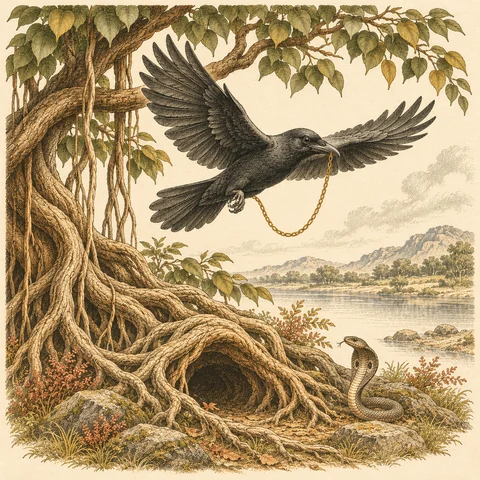
A guest who asks for friendship
Spot comes to the lake exhausted by pursuit and looking for water. The resident friends initially retreat, until Swift confirms that no hunter is nearby. Slow offers hospitality, and Spot explicitly seeks membership in their circle. When the turtle questions what small creatures can offer him, the deer values their learning and companionship. The request changes his life from solitary evasion to participation in a community whose varied abilities can answer dangers no one member controls.
Source: Panchatantra, Book 2: The Winning of Friends · Book II, frame before The Mice That Set Elephants Free
Experience does not prevent capture
Later, Spot fails to attend the friends’ regular meeting because he is trapped. Swift finds him and brings Gold. While awaiting release, Spot recalls an earlier captivity in a royal household, when his unexpected speech alarmed a prince and he was eventually returned to the forest. The recollection makes his present predicament a recurrence despite experience. The narrative does not claim that intelligence makes creatures invulnerable; judgment still has to work within events they could not fully foresee.
Source: Panchatantra, Book 2: The Winning of Friends · Book II, frame introducing Spot’s Captivity and the named tale
From rescued to indispensable
After Gold cuts Spot free, the hunter catches Slow instead. Spot then becomes the decoy in a coordinated rescue: he lies beside water as if dead while Swift appears to peck his eyes. The hunter abandons the bound turtle to pursue this more attractive prize. Spot waits until the man approaches, then runs. He repays assistance through a bodily skill especially his own, while depending on his friends to make the performance and timing succeed.
Source: Panchatantra, Book 2: The Winning of Friends · Book II, frame after Spot’s Captivity: capture and release of Slow
- Period / witness
- Purnabhadra recension dated 1199 CE; Arthur W. Ryder translation published 1925. These dates identify textual witnesses, not the first telling of every episode.
- Recording context
- Panchatantra in Arthur W. Ryder’s 1925 English translation of the Purnabhadra recension; passages are identified by book, named tale, and the surrounding frame narrative.
A recording location is not necessarily a story’s origin. Dates of texts, copies, and translations answer different questions.
Explore time & place →Read the sources
These references support the explanation above. Rights and edition notes are recorded individually.
Panchatantra, Book 2: The Winning of Friends ↗
Pūrṇabhadra recension (1199 CE); English translation by Arthur W. Ryder (1877–1938), based on Johannes Hertel’s Sanskrit edition · Pūrṇabhadra recension 1199 CE; Hertel edition 1908; Ryder translation 1925
Edition & rights note