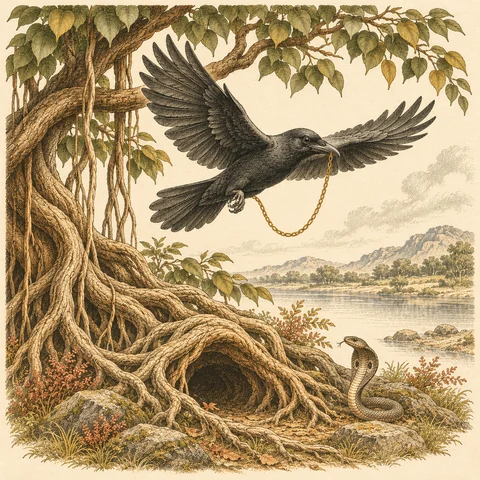
Strength on a small scale
Gold lives in a carefully prepared burrow with numerous entrances. When Gay-Neck brings his trapped doves, the mouse’s teeth can do what the flock’s wings cannot: remove the net altogether. The dove king requests freedom for his followers before himself, and Gold ultimately releases everyone. Their exchange makes the rescue more than a demonstration of useful anatomy. It also tests whether authority places its dependents first when help might run out before all are safe.
Source: Panchatantra, Book 2: The Winning of Friends · Book II, opening frame after The Bharunda Birds: Gay-Neck reaches Gold’s burrow
Trust is examined
Swift watches the rescue and seeks Gold’s friendship. Gold initially refuses because a crow can eat a mouse; declarations of goodwill do not immediately erase that danger. Their extended discussion ends in trust, followed by reciprocal gifts of food. When drought drives Swift to leave, Gold agrees to ride on his back. Friendship becomes an arrangement demonstrated through conversation and action, not a miraculous abolition of all risks between animals of different kinds.
Source: Panchatantra, Book 2: The Winning of Friends · Book II, frame between The Bharunda Birds and Gold’s Gloom
After the loss of wealth
At Slow’s lake, Gold recounts how ascetics discovered and took the hoard beneath his former home. His extraordinary energy vanished with it, and an attempt at recovery nearly killed him. Yet the larger frame gives him continuing value beyond money: he frees Spot and designs the rescue of captured Slow. The group’s survival depends on his judgment and skills. His lament about poverty is thus placed beside evidence that friendship can provide resources his missing treasure cannot.
Source: Panchatantra, Book 2: The Winning of Friends · Book II, Gold’s Gloom; frame after Spot’s Captivity and final rescue
- Period / witness
- Purnabhadra recension dated 1199 CE; Arthur W. Ryder translation published 1925. These dates identify textual witnesses, not the first telling of every episode.
- Recording context
- Panchatantra in Arthur W. Ryder’s 1925 English translation of the Purnabhadra recension; passages are identified by book, named tale, and the surrounding frame narrative.
A recording location is not necessarily a story’s origin. Dates of texts, copies, and translations answer different questions.
Explore time & place →Read the sources
These references support the explanation above. Rights and edition notes are recorded individually.
Panchatantra, Book 2: The Winning of Friends ↗
Pūrṇabhadra recension (1199 CE); English translation by Arthur W. Ryder (1877–1938), based on Johannes Hertel’s Sanskrit edition · Pūrṇabhadra recension 1199 CE; Hertel edition 1908; Ryder translation 1925
Edition & rights note