A messenger carries increasingly difficult words
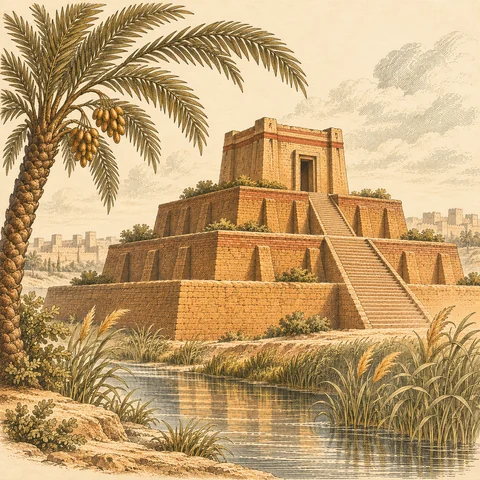
In Enmerkar and the Lord of Aratta, Uruk’s ruler seeks precious materials and work for sacred buildings. Rival claims to Inana’s favor generate repeated embassies. Grain, an unusual container, a sceptre, and demands for a suitable champion become problems through which each ruler tests the other.
Eventually the message exceeds what the messenger can repeat. Enmerkar puts it into clay writing. The receiving ruler confronts the tablet, while a storm brings relief to Aratta’s hunger and renews his claim that Inana has not abandoned the city.
The late sequence is damaged, although it includes abundance and work connected with precious materials. It should not be flattened into a fully preserved final surrender. Writing appears within the story as a response to an overloaded messenger; that literary explanation is not an archaeological date for writing’s invention. The poem makes communication itself one of the resources over which ambitious rulers struggle.
Source: Enmerkar and the lord of Aratta — ETCSL 1.8.2.3 · ETCSL 1.8.2.3, lines 1–104, 260–411, 412–499, 500–636
A sorcerer and a wise opponent
Enmerkar and En-suhgir-ana names the rival ruler and gives the contest a different course. Both claim privileged intimacy with Inana. En-suhgir-ana refuses his advisers’ recommendation to retreat and employs a sorcerer, Ur-girnuna, whose attack disrupts the dairy supply at Eresh.
Herds suffer and their keepers appeal for help. The wise woman Sagburu confronts the sorcerer through a series of creatures brought from the river. Her predators overcome his animals. He begs to return safely to Aratta, but she condemns the damage to food supplies and kills him.
After hearing of the defeat, En-suhgir-ana acknowledges Enmerkar’s superiority. This ending is more explicit than the damaged conclusion of the other poem. The accounts can be compared as rival-city literature without assigning every embassy and magical duel to one continuous campaign. Their practical concerns also differ: temple materials and communication dominate one, while the interruption and defense of nourishment drive the other.
Source: Enmerkar and En-suhgir-ana — ETCSL 1.8.2.4 · ETCSL 1.8.2.4, lines 25–169, 170–227, 228–273, 274–283
- Period / witness
- Sumerian literary compositions in a corpus of late-third- and early-second-millennium BCE witnesses; selected Oxford translations, 1998–2000. Separate Akkadian comparisons retain their own transmission.
- Recording context
- Two distinct Sumerian compositions, ETCSL 1.8.2.3 and 1.8.2.4; names are lightly normalized from the project’s transliteration, and damaged conclusions remain marked.
A recording location is not necessarily a story’s origin. Dates of texts, copies, and translations answer different questions.
Explore time & place →Read the sources
These references support the explanation above. Rights and edition notes are recorded individually.
Enmerkar and the lord of Aratta — ETCSL 1.8.2.3 ↗
Jeremy Black, Graham Cunningham, Esther Flückiger-Hawker, Eleanor Robson, Jon Taylor, Gábor Zólyomi, and credited ETCSL contributors · 1998 translation; corrections and HTML 1999; formatting revision 2001; composite edition of ancient Sumerian witnesses, not a single surviving complete manuscript.
Edition & rights noteEnmerkar and En-suhgir-ana — ETCSL 1.8.2.4 ↗
Jeremy Black, Graham Cunningham, Esther Flückiger-Hawker, Eleanor Robson, Jon Taylor, Gábor Zólyomi, and credited ETCSL contributors · 1998 translation adaptation; corrections and HTML 1999; formatting revision 2001; composite edition of ancient Sumerian witnesses, not a single surviving complete manuscript.
Edition & rights note