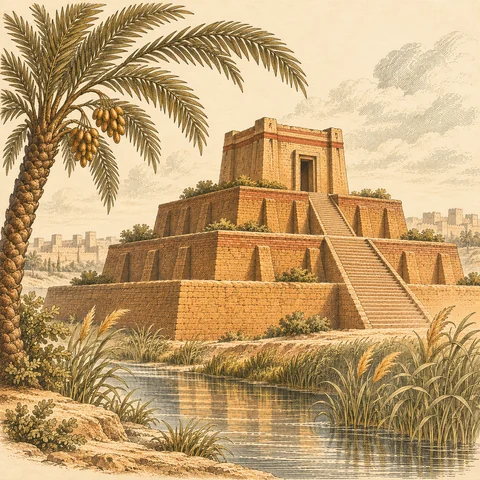
The mountain cave
During Enmerkar’s expedition toward Aratta, Lugalbanda falls seriously ill. His companions leave him in a cave with provisions, planning to return. Isolated from the army, he appeals to divine helpers, and the poem addresses Utu, Inana, and Suen across changing times of day.
Lugalbanda obtains life-saving plants and water, recovers enough to move, and learns to manage food and fire in the mountains. He captures animals, then receives a dream directing a sacrifice. He carries it out and prepares a divine banquet.
The surviving composition continues into difficult descriptions of supernatural beings and breaks off; a doubtful fragment is separately marked by the editors. Its recovery episode is substantial, but the damaged ending cannot supply an invented triumphant return. The poem’s hero first becomes remarkable through need, prayer, and resourcefulness. Military membership does not protect him from bodily collapse or make solitary survival an effortless test of strength.
Source: Lugalbanda in the mountain cave — ETCSL 1.8.2.1 · ETCSL 1.8.2.1, lines 1–132, 133–275, 276–393, 394–499 and segment B
The bird’s gift and the message
In the companion poem, Lugalbanda feeds and adorns Anzud’s chick while its parents are absent. The returning bird offers rewards. Lugalbanda rejects several forms of abundance or martial power and asks for tireless movement. Anzud grants it, helping him rejoin his comrades while telling him to keep the gift private.
The army remains stalled outside Aratta. Lugalbanda volunteers to carry Enmerkar’s message alone to Inana at Uruk. His companions fear the journey, but his new capacity brings him swiftly to the goddess. She gives instructions involving a special fish and an offering that will undermine Aratta’s strength.
The poem ends with that guidance and praise, rather than an extended account of the city’s capture. Read beside the cave poem, the gift answers a traveler’s vulnerability with mobility and service. The two compositions remain distinct witnesses; the second does not repair every missing line at the end of the first.
Source: Lugalbanda (the Anzud-bird composition) — ETCSL 1.8.2.2 · ETCSL 1.8.2.2, lines 1–131, 132–250, 251–387, 388–417
- Period / witness
- Sumerian literary compositions in a corpus of late-third- and early-second-millennium BCE witnesses; selected Oxford translations, 1998–2000. Separate Akkadian comparisons retain their own transmission.
- Recording context
- Two separately catalogued Sumerian compositions, ETCSL 1.8.2.1 and 1.8.2.2. Their related hero and setting justify reading together, without pretending they survive as an uninterrupted single manuscript.
A recording location is not necessarily a story’s origin. Dates of texts, copies, and translations answer different questions.
Explore time & place →Read the sources
These references support the explanation above. Rights and edition notes are recorded individually.
Lugalbanda in the mountain cave — ETCSL 1.8.2.1 ↗
Jeremy Black, Graham Cunningham, Esther Flückiger-Hawker, Eleanor Robson, Jon Taylor, Gábor Zólyomi, and credited ETCSL contributors · 1998 translation adaptation; corrections and HTML 1999; formatting revision 2001; composite edition of ancient Sumerian witnesses, not a single surviving complete manuscript.
Edition & rights noteLugalbanda (the Anzud-bird composition) — ETCSL 1.8.2.2 ↗
Jeremy Black, Graham Cunningham, Esther Flückiger-Hawker, Eleanor Robson, Jon Taylor, Gábor Zólyomi, and credited ETCSL contributors · 1998 translation adaptation; HTML 1999; formatting revision 2001; composite edition of ancient Sumerian witnesses, not a single surviving complete manuscript.
Edition & rights note