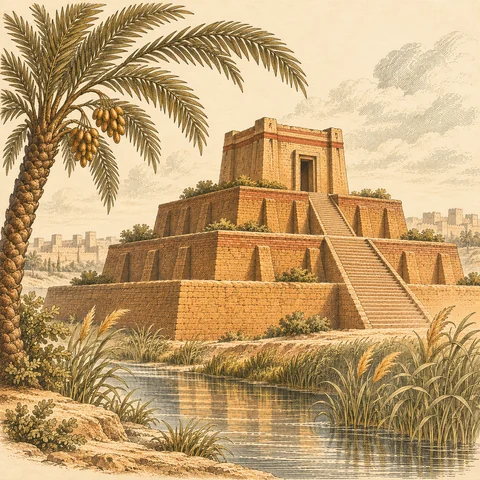
A named sacred center
In the bilingual creation passage, Babylon and Esagil appear as the world moves from an expanse of water and absent institutions toward a setting fit for habitation. Naming the city at this point gives it theological importance. The passage does not present urban construction as an afterthought unrelated to the making of life.
This is a claim made by a specific literary and ritual composition. It should not be turned into a neutral description of the first city in historical time. The text’s interest is the significance of a sacred center, not an excavation report.
Source: Cuneiform Parallels to the Old Testament: selected primary translations · Bilingual creation text, lines 1–21, pp. 47–49
The city must keep asking
The processional hymn asks Marduk to be at peace and to look favorably on Babylon and its sanctuary. Gates, bolts, and locks belong to the language of the appeal, while the colophon places the performance at a return to Esagil during the New Year.
The city’s elevated position does not make care automatic. It must be voiced and renewed through ritual. This gives the creation and procession passages complementary work: one situates a city within the origins of order, while the other asks that order to remain protective in the present. The praise is local and purposeful, even when its language gathers the wider divine community around it.
Source: Cuneiform Parallels to the Old Testament: selected primary translations · Processional Hymn to Marduk, lines 10–37 and colophon, pp. 151–153
- Period / witness
- Selected Sumerian and Akkadian literary witnesses, with a separately identified Greek-mediated account; modern editions 1912, 1920, and 1998–2001. Narrative time is not a historical date.
- Recording context
- Selected cuneiform compositions in Robert W. Rogers’s 1912 edition. Individual tablets, languages, and textual gaps are distinguished in the article; this is not a single Mesopotamian canon.
A recording location is not necessarily a story’s origin. Dates of texts, copies, and translations answer different questions.
Explore time & place →Read the sources
These references support the explanation above. Rights and edition notes are recorded individually.
Cuneiform Parallels to the Old Testament: selected primary translations ↗
Robert William Rogers, translator and editor (1864–1930) · 1912 English edition of selected cuneiform texts and a Greek-mediated Berossos account; ancient witnesses vary by composition.
Edition & rights note