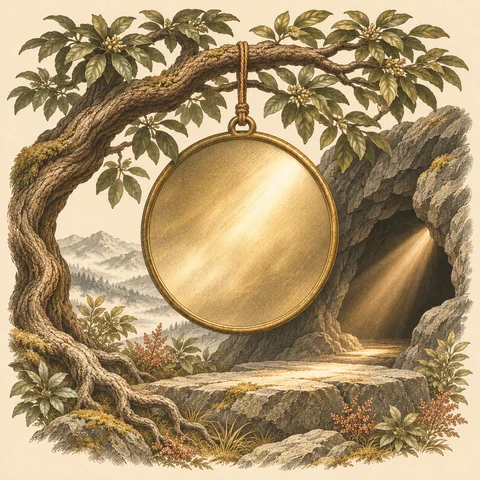
Darkness follows an attack
Susanoo's conduct escalates from damage to fields to an intrusion into Amaterasu's weaving hall. He drops a flayed horse through its roof, terrifying the weaving women and causing death. Amaterasu withdraws behind the door of a heavenly rock dwelling. Darkness spreads over heaven and the land below; harmful disturbances multiply.
The other deities assemble beside the heavenly river and ask Omoikane to devise a response. Their solution does not begin with a single champion attacking the door. They gather birds, obtain materials, commission a mirror and jewels, perform divination, and prepare a branching tree bearing offerings. Many kinds of knowledge are needed because the crisis concerns the whole community.
Source: Kojiki: Records of Ancient Matters, Chamberlain translation · Kojiki §§15–16, withdrawal and preparations
Laughter creates an opening
Ame-no-Uzume performs before the entrance, stamping on a sounding surface and exposing her body in a startling display. The assembled deities laugh. Amaterasu, expecting darkness and distress outside, becomes curious about the unexpected celebration. She opens the door slightly and asks why everyone is rejoicing.
Uzume answers that a deity more splendid than Amaterasu is present. The mirror is brought forward. Amaterasu comes farther out to look, and the strong-handed deity waiting beside the opening takes her hand and draws her clear. Another deity stretches a rope behind her, establishing a boundary that prevents an immediate retreat. The mirror works within this carefully arranged sequence of attention, curiosity, movement, and restraint.
Source: Kojiki: Records of Ancient Matters, Chamberlain translation · Kojiki §16, performance and emergence
Light returns, responsibility remains
With Amaterasu outside, both realms become bright again. The divine assembly then imposes penalties on Susanoo and expels him. The return of light therefore does not erase the conduct that caused the crisis. Restoration includes an action against the disruptive participant as well as assistance to the withdrawn one.
The Kojiki later associates members of this cooperative effort with ritual and craft lineages. That makes the scene important to the compilation's account of authority and service. It should not, however, be treated as a documentary record of the first historical performance of every related rite. Nor does the story itself require an astronomical diagnosis such as a particular eclipse. Its explicit problem is a damaged divine relationship, answered through a collective intervention.
Source: Kojiki: Records of Ancient Matters, Chamberlain translation · Kojiki §§16–17; §33, named companions and ancestral affiliations
- Period / witness
- Kojiki presented in 712 CE; Chamberlain translation 1882. Narrative time is not a historical date.
- Recording context
- Kojiki, a Japanese court compilation attributed to Ō no Yasumaro from material recited by Hieda no Are; cited by Chamberlain’s numbered sections, not asserted as the origin of the tradition.
A recording location is not necessarily a story’s origin. Dates of texts, copies, and translations answer different questions.
Explore time & place →Read the sources
These references support the explanation above. Rights and edition notes are recorded individually.
Kojiki: Records of Ancient Matters, Chamberlain translation ↗
Ō no Yasumaro (compiler, as identified in the preface); translated by Basil Hall Chamberlain (1850–1935) · Court compilation presented 712 CE; translation published Yokohama, 1882
Edition & rights note