An audience makes the performance work
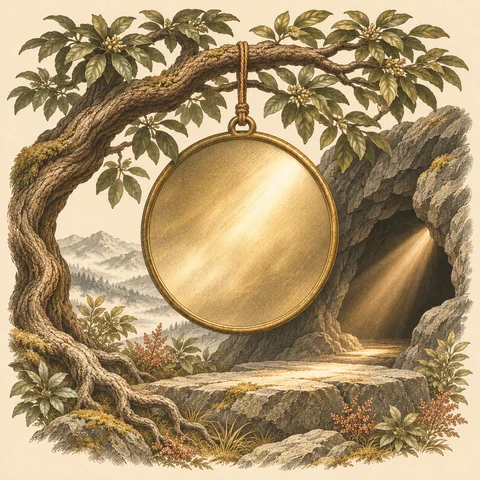
Uzume's stamping and bodily exposure before the rock dwelling cause the assembled deities to laugh. Amaterasu hears a response that contradicts her expectation of universal darkness and grief. Uzume then answers the goddess's question in a way that draws her attention toward the mirror. Her performance is part of an arranged collaboration, with other participants providing objects, words, and the physical action that completes the emergence.
Source: Kojiki: Records of Ancient Matters, Chamberlain translation · Kojiki §16
Facing an unknown presence
Before Ninigi descends, a radiant being occupies the heavenly crossroads. Uzume is chosen to question him because she can confront other deities directly. The stranger identifies himself as Sarutahiko and offers to guide the expedition. The scene values her capacity to speak at an uncertain boundary as much as the cave scene values performance. She makes the meaning of a potentially obstructing presence clear before the travelers proceed.
Source: Kojiki: Records of Ancient Matters, Chamberlain translation · Kojiki §33
Service, names, and lineage
She accompanies Sarutahiko and is associated with the Sarume women. A following episode makes her demand the allegiance of sea creatures and slit the mouth of the one that does not answer. This harsher action should remain beside the celebratory image of a dancer. The compilation links her acts to named offices and offerings, but it does not warrant treating every later performance tradition as an unchanged survival of this narrated event.
Source: Kojiki: Records of Ancient Matters, Chamberlain translation · Kojiki §§35–36
- Period / witness
- Kojiki presented in 712 CE; Chamberlain translation 1882. Narrative time is not a historical date.
- Recording context
- Kojiki, a Japanese court compilation attributed to Ō no Yasumaro from material recited by Hieda no Are; cited by Chamberlain’s numbered sections, not asserted as the origin of the tradition.
A recording location is not necessarily a story’s origin. Dates of texts, copies, and translations answer different questions.
Explore time & place →Read the sources
These references support the explanation above. Rights and edition notes are recorded individually.
Kojiki: Records of Ancient Matters, Chamberlain translation ↗
Ō no Yasumaro (compiler, as identified in the preface); translated by Basil Hall Chamberlain (1850–1935) · Court compilation presented 712 CE; translation published Yokohama, 1882
Edition & rights note