A realm assigned
In the Kojiki's purification account, Amaterasu appears when Izanagi washes his left eye. He gives her the heavenly plain and a necklace as part of assigning responsibilities to three exceptional children. Her later confrontation with Susanoo is therefore territorial as well as familial. She prepares herself as an armed ruler because she fears that his dramatic arrival signals a challenge to the realm entrusted to her.
Source: Kojiki: Records of Ancient Matters, Chamberlain translation · Kojiki §§10–13
A ruler who needs others
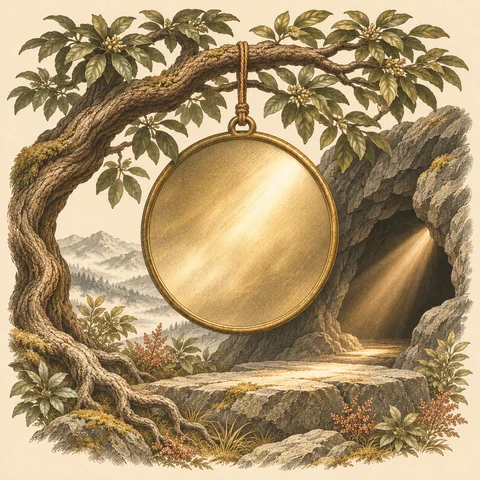
Her withdrawal into the rock dwelling brings darkness to heaven and earth. The return depends on Omoikane's planning, craft specialists, divination, Uzume's performance, a mirror, and an assisting hand. Her importance does not imply that she performs every necessary act herself. The narrative makes her indispensable while also making her restoration a collective achievement, a distinction lost when the event is summarized only as a goddess changing her mood.
Source: Kojiki: Records of Ancient Matters, Chamberlain translation · Kojiki §§15–16
Presence in a transmitted object
When her descendant is sent down, the mirror is entrusted to the expedition with instructions to honor it as her presence. The episode joins heavenly authority to material custody and descendant groups. These are claims within an eighth-century court compilation, not independent proof of the genealogy it promotes. The selected Nihon Shoki food account also shows her condemning Tsukuyomi and organizing recovered seeds, a different narrative emphasis from the cave episode.
Sources: Kojiki: Records of Ancient Matters, Chamberlain translation; Nihongi / Nihon Shoki, Book I · Kojiki §33; Nihon Shoki Book I, Aston vol. I, pp. 32–33
- Period / witness
- Kojiki presented in 712 CE; Chamberlain translation 1882. Narrative time is not a historical date.
- Recording context
- Kojiki, a Japanese court compilation attributed to Ō no Yasumaro from material recited by Hieda no Are; cited by Chamberlain’s numbered sections, not asserted as the origin of the tradition.
A recording location is not necessarily a story’s origin. Dates of texts, copies, and translations answer different questions.
Explore time & place →Read the sources
These references support the explanation above. Rights and edition notes are recorded individually.
Kojiki: Records of Ancient Matters, Chamberlain translation ↗
Ō no Yasumaro (compiler, as identified in the preface); translated by Basil Hall Chamberlain (1850–1935) · Court compilation presented 712 CE; translation published Yokohama, 1882
Edition & rights noteNihongi / Nihon Shoki, Book I ↗
Japanese court compilation; translated by William George Aston (1841–1911) · Compilation completed 720 CE; translation 1896; selected passage vol. I, pp. 32–33
Edition & rights note