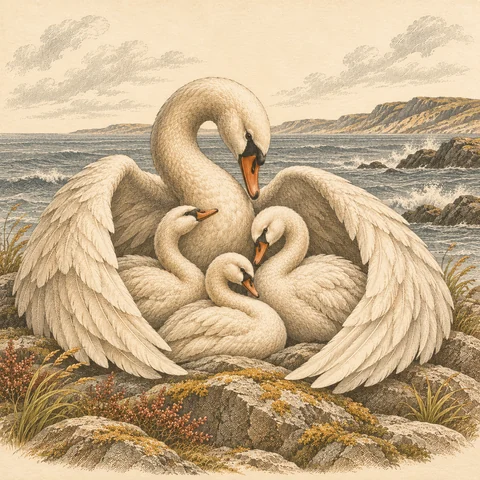
The destination appears too soon
Máel Dúin finds the killers' island near the beginning of his journey, only to be driven away before attacking. The long sequence of wonders is therefore not simply a search for an unknown address. The destination is already recognizable. What remains unresolved is whether the voyager will return to it as the same person pursuing the same act.
Source: The Voyage of Maildun — Joyce adaptation · The Voyage of Maildun, chapters I–II: revenge intention, recognition and storm
A confession supplies the decisive instruction
The sea-rock hermit recounts theft, pride, forced abandonment of treasure, and years sustained by divine provision. His own story turns on receiving a future after wrongdoing. He then directs Máel Dúin to extend comparable mercy to the murderer. The advice is explicitly grounded in God's preservation of the travelers, making Christian moral reasoning central to this selected version's resolution.
Source: The Voyage of Maildun — Joyce adaptation · The Voyage of Maildun, chapter XXXIII: hermit’s history and instruction to forgive
A comparison with a quest that does not reconcile
The final welcome from the former enemy makes Máel Dúin's homecoming possible without vengeance. Tuireann's sons complete an extraordinary journey too, but Lugh refuses to let fulfillment become reconciliation. The contrast concerns the differing moral work of travel in Joyce's adaptations. It does not demonstrate borrowing between tales or turn every Irish sea journey into the same lesson about forgiveness.
Sources: The Voyage of Maildun — Joyce adaptation; The Fate of the Children of Turenn — Joyce adaptation · The Voyage of Maildun, chapters XXXIV–XXXV: return and hospitality; The Fate of the Children of Turenn, chapter XV: final refusal
- Period / witness
- Irish literary romance in Joyce’s historical adaptation; the consulted printed edition is dated 1920.
- Recording context
- Read through P. W. Joyce’s Old Celtic Romances, a literary translation and adaptation whose preface acknowledges freely recast wording, comparison of manuscript copies, and added chapter divisions. The 1920 print witness is distinct from the age of its underlying tale.
A recording location is not necessarily a story’s origin. Dates of texts, copies, and translations answer different questions.
Explore time & place →Read the sources
These references support the explanation above. Rights and edition notes are recorded individually.
The Voyage of Maildun — Joyce adaptation ↗
Irish literary narrative; translated and adapted by Patrick Weston Joyce (1827–1914) · Consulted print edition dated 1920; preface to the third edition dated 1907; Project Gutenberg release 17 November 2011
Edition & rights noteThe Fate of the Children of Turenn — Joyce adaptation ↗
Irish literary narrative; translated and adapted by Patrick Weston Joyce (1827–1914) · Consulted print edition dated 1920; preface to the third edition dated 1907; Project Gutenberg release 17 November 2011
Edition & rights note