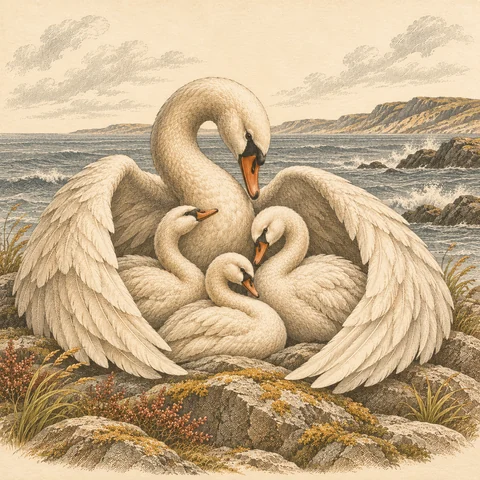
An expedition with the wrong number
Máel Dúin grows up in a royal foster-household without knowing his parentage. Taunts lead him to discover that raiders killed his father inside a church. He resolves to pursue them and obtains a druid's instructions for building a boat and selecting its crew. Joyce's version specifies sixty men. Three foster-brothers insist on joining and swim after the departing vessel, so he takes them aboard rather than let them drown.
The voyagers almost immediately find the killers' island and overhear a boast about the murder. Before they can attack, a storm drives them away. Máel Dúin attributes their trouble to the excess passengers, while also entrusting the drifting boat to God. Druidic instructions and Christian providence coexist in the narrated voyage.
Source: The Voyage of Maildun — Joyce adaptation · The Voyage of Maildun, chapters I–II: parentage, revenge plan, crew, foster-brothers and first sight of the enemy
Hospitality, appetite, and the cost of escape
The long wandering passes through islands that demand different judgments. In a richly furnished palace, food and rest appear available, but a little cat kills the foster-brother who steals a necklace. Other companions become absorbed into communities of weeping or laughter. A welcoming island queen offers a life without aging, yet repeatedly draws the departing boat back with a thread that adheres to a passenger's hand.
The crew finally escapes the queen only when Diuran cuts off the caught man's hand. Such episodes make the voyage more complicated than a procession of attractive wonders. Generosity can have limits, pleasure can prevent departure, and survival can impose severe costs. The account explained here selects these scenes rather than pretending that every island is an interchangeable symbol.
Source: The Voyage of Maildun — Joyce adaptation · Chapters XII, XVI, XXVIII and XXXI: cat palace, weeping island, queen’s thread and laughing island
The lesson that changes the destination
A penitent hermit tells the travelers how he abandoned stolen wealth and came to live under divine provision. He advises Máel Dúin to forgive the man who killed his father, as God has spared the voyagers through their dangers. When they reach the original island again, they overhear the killer saying he would now welcome the long-suffering traveler.
Máel Dúin announces himself, accepts hospitality, and returns home without the revenge he set out to perform. Diuran deposits silver from the journey at Armagh, giving the wonders a material memorial. Joyce's retelling is strongly Christian in its conclusion; his prefatory conjecture that an actual voyage underlies the story is not treated here as established history.
Source: The Voyage of Maildun — Joyce adaptation · Chapters XXXIII–XXXV: hermit’s confession and advice, enemy’s welcome, homecoming and silver offering; preface, The Voyage of Maildun
- Period / witness
- Irish literary romance in Joyce’s historical adaptation; the consulted printed edition is dated 1920.
- Recording context
- Read through P. W. Joyce’s Old Celtic Romances, a literary translation and adaptation whose preface acknowledges freely recast wording, comparison of manuscript copies, and added chapter divisions. The 1920 print witness is distinct from the age of its underlying tale.
A recording location is not necessarily a story’s origin. Dates of texts, copies, and translations answer different questions.
Explore time & place →Read the sources
These references support the explanation above. Rights and edition notes are recorded individually.
The Voyage of Maildun — Joyce adaptation ↗
Irish literary narrative; translated and adapted by Patrick Weston Joyce (1827–1914) · Consulted print edition dated 1920; preface to the third edition dated 1907; Project Gutenberg release 17 November 2011
Edition & rights note