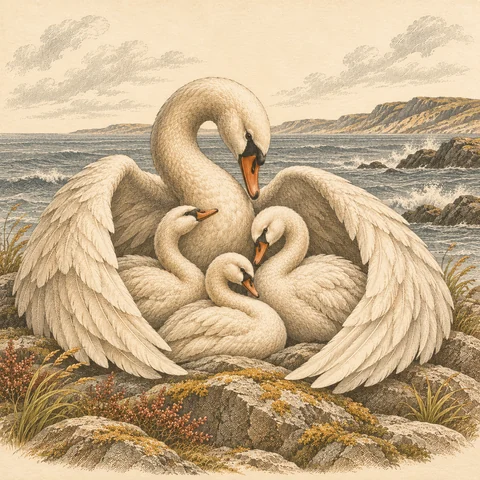
A killing that the ground reveals
Cian, father of Lugh, travels to gather allies against the Fomorians. Seeing three hereditary enemies approach, he takes a pig's shape to hide among a herd. Brian, the most forceful of Tuireann's three sons, recognizes the trick and turns his brothers into hounds to expose him. Cian asks to resume human form before dying, ensuring that compensation will be reckoned for a man rather than an animal.
The brothers kill him with stones, hoping to prevent their weapons from revealing the crime. The ground repeatedly rejects the body, and later the stones disclose the murder to Lugh. At a public assembly Lugh secures an agreement to accept a fine, with the community acting as guarantor. Only after the terms are accepted does he explain how difficult the apparently ordinary objects will be to obtain.
Source: The Fate of the Children of Turenn — Joyce adaptation · The Fate of the Children of Turenn, chapters II and IV: Cian’s death, discovery and public agreement
Power acquired through further violence
The demands include healing apples, a curative pig's skin, a blazing spear, sea-traveling horses, inexhaustible pigs, a marvelous hound, a cooking-spit, and three shouts on a guarded hill. Manannán's boat carries the brothers between distant kingdoms. They use transformations, false poetic identities, service agreements, and combat to obtain the objects. Several rulers die resisting them.
Not every exchange ends in slaughter. Asal gives his pigs and intercedes for his son-in-law, whose life Brian eventually spares. The underwater women possessing the spit also choose to release it. These exceptions make negotiation imaginable within the quest, even while the brothers repeatedly describe their violence as something the original fine has forced upon them.
Source: The Fate of the Children of Turenn — Joyce adaptation · Chapters V–XI and XIII: boat, apples, skin, spear, horses, Asal, hound and underwater cooking-spit
A cure deliberately withheld
Lugh causes the brothers to forget the final tasks and return with the useful treasures first. After handing them over, they must depart again without their healing resources. They win the last combat and utter the required shouts, but are mortally wounded. Their father begs Lugh for healing apples, and Brian repeats the appeal himself. Lugh refuses: the completed payment has not exhausted his desire for their deaths.
The brothers die together, followed in Joyce's ending by their grieving father and sister. The tale exposes a tension between compensation as settlement and compensation as prolonged revenge. Joyce acknowledges altered names and an omitted introductory episode; his full quest derives from later manuscript copies alongside older notices of the brothers. This is his mediated narrative, not a reconstruction of one uniformly dated myth.
Source: The Fate of the Children of Turenn — Joyce adaptation · Chapters XII–XV: induced forgetting, final tasks, refused apples and deaths; preface, The Fate of the Children of Turenn
- Period / witness
- Irish literary romance in Joyce’s historical adaptation; the consulted printed edition is dated 1920.
- Recording context
- Read through P. W. Joyce’s Old Celtic Romances, a literary translation and adaptation whose preface acknowledges freely recast wording, comparison of manuscript copies, and added chapter divisions. The 1920 print witness is distinct from the age of its underlying tale.
A recording location is not necessarily a story’s origin. Dates of texts, copies, and translations answer different questions.
Explore time & place →Read the sources
These references support the explanation above. Rights and edition notes are recorded individually.
The Fate of the Children of Turenn — Joyce adaptation ↗
Irish literary narrative; translated and adapted by Patrick Weston Joyce (1827–1914) · Consulted print edition dated 1920; preface to the third edition dated 1907; Project Gutenberg release 17 November 2011
Edition & rights note