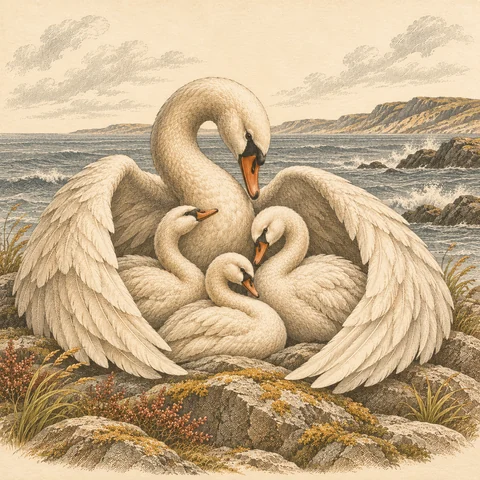
A second stage of exile
Joyce's children of Lir move from the comparatively social life of Lake Darvra to three hundred years on the Sea of Moyle. The narrator identifies the waters between Ireland and Scotland. The shift changes the terms of their suffering: people can no longer remain continually beside them, and open sea replaces the sheltered setting where conversation and music sustained a community.
Source: The Fate of the Children of Lir — Joyce adaptation · The Fate of the Children of Lir, chapters III–V: assigned periods, departure and description of Moyle
A meeting place against dispersal
Before a storm, Fionnuala names a rock where the siblings should reunite if separated. Her planning makes a particular point in the landscape a tool of survival. Later, ice binds their bodies to that rock, and returning to the salt water wounds them further. The same location can provide orientation without providing safety from the conditions surrounding it.
Source: The Fate of the Children of Lir — Joyce adaptation · Chapter V: appointed rock, storm reunion, freezing and wounded return to the water
Contact does not undo the sentence
A visiting company from their former people brings news of home, but cannot remove the swans from their appointed waters. The episode allows connection without rescue. Joyce's detailed localization gives the literary suffering geographical texture; it is not evidence that the narrated nine-century chronology can be matched to an actual period of settlement, kingship, or remembered environmental disaster.
Source: The Fate of the Children of Lir — Joyce adaptation · Chapter V: meeting with Bodb’s sons and return to the appointed sea; chapter VI: move west
- Period / witness
- Irish literary romance in Joyce’s historical adaptation; the consulted printed edition is dated 1920.
- Recording context
- Read through P. W. Joyce’s Old Celtic Romances, a literary translation and adaptation whose preface acknowledges freely recast wording, comparison of manuscript copies, and added chapter divisions. The 1920 print witness is distinct from the age of its underlying tale.
A recording location is not necessarily a story’s origin. Dates of texts, copies, and translations answer different questions.
Explore time & place →Read the sources
These references support the explanation above. Rights and edition notes are recorded individually.
The Fate of the Children of Lir — Joyce adaptation ↗
Irish literary narrative; translated and adapted by Patrick Weston Joyce (1827–1914) · Consulted print edition dated 1920; preface to the third edition dated 1907; Project Gutenberg release 17 November 2011
Edition & rights note