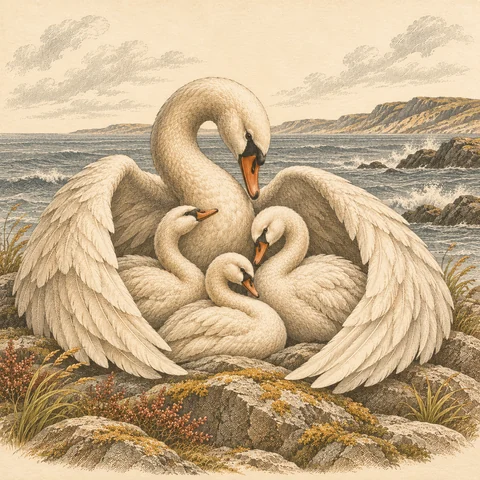
A chosen departure
Oisín narrates the tale printed by Joyce as a memory of his life among the warriors. Niamh arrives on a white horse and declares that reports of his character have brought her from the Land of Youth. She offers marriage, beauty, abundance, and freedom from aging. He returns her love and agrees to leave, despite Fionn's sorrow and fear that they will never meet again.
The horse crosses the sea as readily as land. On the journey, Oisín stops to rescue an imprisoned woman from a giant. The episode retains his identity as a champion even while he moves beyond Ireland. After recovering from the combat, he continues to Niamh's country, where her parents welcome him and the marriage is celebrated.
Source: Oisin in Tirnanoge — Joyce adaptation · Oisin in Tirnanoge: Niamh’s arrival, Fionn’s farewell, sea crossing, captive princess and arrival at the palace
A return governed by a warning
More than three hundred years pass in the Land of Youth, although Oisín experiences them as only three. He longs to see Fionn and his companions. Niamh consents reluctantly and warns three times that he must not place his feet on Irish ground. The white horse can carry him back, but leaving it will prevent his return to her.
Ireland has changed. The people seem small beside him and know the Fianna through inherited stories and books. They even know a story about Oisín disappearing with a supernatural woman. He has become a figure in other people's accounts while remaining alive in his own understanding. Allen and the other former dwellings are ruined, so visiting the landscape cannot restore the relationships attached to it.
Source: Oisin in Tirnanoge — Joyce adaptation · Oisin in Tirnanoge: unequal passage of time, three warnings, changed people, account of Oisín and ruins of Allen
The body catches up with time
At Glenasmole, Oisín helps people struggling beneath a heavy stone. He lifts it from the saddle, but the strain breaks the girth and he lands on the ground. The horse escapes, and age immediately overtakes him. Blind, weak, and bereaved, he survives to tell of the wife and companions he cannot recover.
This ending is not death on the spot, nor a successful second journey to Niamh. Joyce's prose adaptation preserves an elderly narrator whose memory spans incompatible worlds. His prefatory notice identifies a poetic Irish source known to him through later copies and an Ossianic Society edition. Its setting among legendary warriors should therefore remain separate from the date of that textual witness and Joyce's own reshaping.
Source: Oisin in Tirnanoge — Joyce adaptation · Oisin in Tirnanoge: Glenasmole stone, broken saddle-girth, aging and concluding narration; Joyce’s prefatory notice
- Period / witness
- Irish literary romance in Joyce’s historical adaptation; the consulted printed edition is dated 1920.
- Recording context
- Read through P. W. Joyce’s Old Celtic Romances, a literary translation and adaptation whose preface acknowledges freely recast wording, comparison of manuscript copies, and added chapter divisions. The 1920 print witness is distinct from the age of its underlying tale.
A recording location is not necessarily a story’s origin. Dates of texts, copies, and translations answer different questions.
Explore time & place →Read the sources
These references support the explanation above. Rights and edition notes are recorded individually.
Oisin in Tirnanoge — Joyce adaptation ↗
Irish literary narrative; translated and adapted by Patrick Weston Joyce (1827–1914) · Consulted print edition dated 1920; preface to the third edition dated 1907; Project Gutenberg release 17 November 2011
Edition & rights note