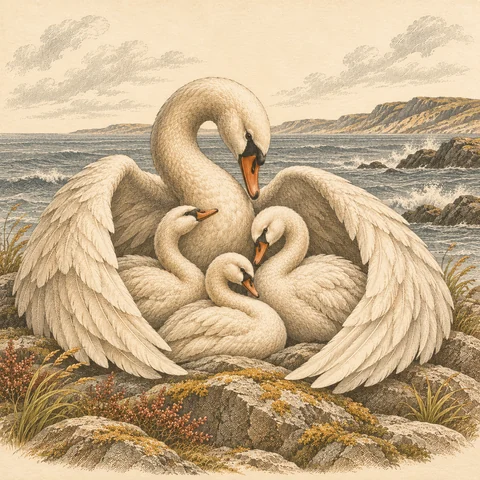
A household with unequal powers
Midir's connection with Étaín begins in the supernatural prologue, where Fuamnach's jealousy drives her from his household. Angus, Midir's foster-son, becomes her protector. The resulting web of marriage, fosterage, and rivalry makes the otherworld resemble a troubled social community. Midir is not simply a remote ruler of an abstract afterlife; he has intimate relationships that fail to protect those involved.
Source: The Courtship of Etain — Leahy translation · Prologue in Fairyland: Midir, Fuamnach, Étaín and Angus
Producing the crisis he offers to solve
When Midir appears in Ailill's likeness, he claims responsibility for both the man's consuming desire and the sleep that prevents the appointments. He has created a route into Étaín's present life by making another person suffer. His offer of a splendid country can therefore be read alongside the coercive means by which he secures her attention, rather than accepted as uncomplicated generosity.
Source: The Courtship of Etain — Leahy translation · Egerton and Leabhar na h-Uidhrí versions: substituted visitor and disclosure of manipulation
Different ways of taking a queen
In one account Midir carries Étaín away from a gathering; in the board-game account he first performs costly services for Eochaid and wins a reciprocal demand. His eventual escape exceeds the king's intended concession. These are differing narrative strategies, not interchangeable details of one fixed event. Leahy's bracketed supplements also require caution when following the resulting war and recovery.
Source: The Courtship of Etain — Leahy translation · Egerton version: gathering and Brí Léith; Leabhar na h-Uidhrí version: games, works and guarded hall
- Period / witness
- Medieval Irish prose and verse preserved in medieval and early modern manuscript witnesses; Leahy translation 1905–1906.
- Recording context
- This entry concerns the literary version named in its passages, transmitted by Christian-era Irish manuscript culture and translated by A. H. Leahy. Legendary settings are not dates of composition or evidence for a single pre-Christian canon.
A recording location is not necessarily a story’s origin. Dates of texts, copies, and translations answer different questions.
Explore time & place →Read the sources
These references support the explanation above. Rights and edition notes are recorded individually.
The Courtship of Etain — Leahy translation ↗
Anonymous Irish literary narratives; translated and arranged by Arthur Herbert Leahy (1857–1928) · Volume I, 1905; Project Gutenberg eBook released May 2004 and updated 29 June 2026
Edition & rights note