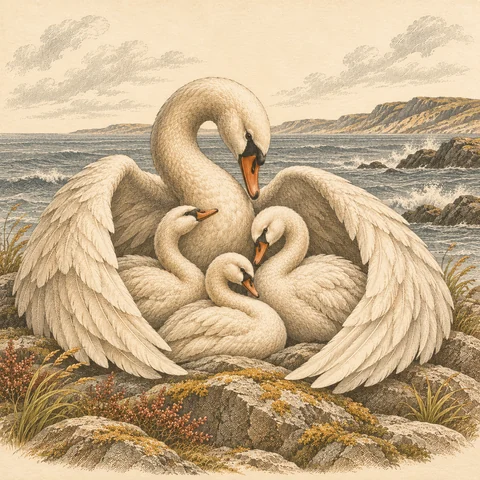
A king expected to have a queen
In Étaín's courtship, the refusal to attend Eochaid's festival until he has a suitable wife makes marriage a condition of public kingship. Tara is where individual household arrangements become visible to the wider realm. This is a literary use of the royal site, not a direct documentary record that every historical assembly operated under the exact rule described.
Source: The Courtship of Etain — Leahy translation · Courtship of Etain, Egerton and Leabhar na h-Uidhrí versions: announcement and conditions of the festival
The guarded hall cannot keep a promise small
The board-game account places armed guards around Eochaid and Étaín when Midir arrives to claim his stake. The preparations cannot prevent his appearance or departure through the roof. The physical security of the center contrasts with the instability of its agreement: the ruler can fill the hall with protectors, yet cannot control what his earlier concession will become.
Source: The Courtship of Etain — Leahy translation · Leabhar na h-Uidhrí version: appointed month, guarded assembly and Midir’s departure
An injury made publicly enforceable
Joyce's Tuireann narrative uses Tara for the assembly where Lugh demands compensation and secures guarantors. The brothers later return their treasures to that same political setting. In both narratives the place concentrates authority, witnesses, and reputational pressure. The comparison concerns these selected literary functions; it does not establish that their different legendary events belong to one recoverable historical chronology.
Source: The Fate of the Children of Turenn — Joyce adaptation · The Fate of the Children of Turenn, chapters IV and XII: public fine and first return
- Period / witness
- Medieval Irish prose and verse preserved in medieval and early modern manuscript witnesses; Leahy translation 1905–1906. Joyce’s Tuireann material is a later literary adaptation.
- Recording context
- This entry concerns the literary version named in its passages, transmitted by Christian-era Irish manuscript culture and translated by A. H. Leahy. Legendary settings are not dates of composition or evidence for a single pre-Christian canon. References to Tuireann follow Joyce’s 1920 print witness.
A recording location is not necessarily a story’s origin. Dates of texts, copies, and translations answer different questions.
Explore time & place →Read the sources
These references support the explanation above. Rights and edition notes are recorded individually.
The Courtship of Etain — Leahy translation ↗
Anonymous Irish literary narratives; translated and arranged by Arthur Herbert Leahy (1857–1928) · Volume I, 1905; Project Gutenberg eBook released May 2004 and updated 29 June 2026
Edition & rights noteThe Fate of the Children of Turenn — Joyce adaptation ↗
Irish literary narrative; translated and adapted by Patrick Weston Joyce (1827–1914) · Consulted print edition dated 1920; preface to the third edition dated 1907; Project Gutenberg release 17 November 2011
Edition & rights note