Continuity without one body
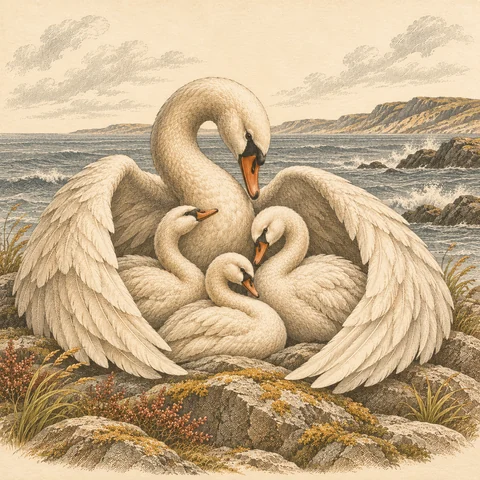
Leahy's prologue follows Étaín from Midir's household through transformation, wind-driven exile, and rebirth. Her second mother swallows her in a drink, making another human life possible without erasing the earlier one. The story's extraordinary chronology marks continuity as a narrative problem: a woman's present family and marriage do not exhaust the relationships that others claim she once possessed.
Source: The Courtship of Etain — Leahy translation · Prologue in Fairyland: Fuamnach’s attacks, Angus’s shelter, swallowing and second birth
Care as an independent motive
As Eochaid's queen, Étaín tends his sick brother Ailill. Her explanation for agreeing to meet him emphasizes rescue from illness, rather than a simple transfer of romantic allegiance. When another man appears in Ailill's likeness, she challenges him. That response matters because Midir attempts to make an identity known only to himself determine what she should now do.
Source: The Courtship of Etain — Leahy translation · Egerton and Leabhar na h-Uidhrí versions: Ailill’s illness, appointments and Étaín’s challenge
The limits of an agreed transfer
The board-game version makes Étaín condition departure on Eochaid's permission, yet his permission to an embrace does not amount to an intended permanent surrender. Midir expands the transaction into removal. The Egerton account stages an abduction without the wager. Keeping those versions separate allows readers to examine the pressures on Étaín without inventing one unchanging statement of her consent.
Source: The Courtship of Etain — Leahy translation · Leabhar na h-Uidhrí version: conditional agreement and roof departure; Egerton version: Fremain abduction
- Period / witness
- Medieval Irish prose and verse preserved in medieval and early modern manuscript witnesses; Leahy translation 1905–1906.
- Recording context
- This entry concerns the literary version named in its passages, transmitted by Christian-era Irish manuscript culture and translated by A. H. Leahy. Legendary settings are not dates of composition or evidence for a single pre-Christian canon.
A recording location is not necessarily a story’s origin. Dates of texts, copies, and translations answer different questions.
Explore time & place →Read the sources
These references support the explanation above. Rights and edition notes are recorded individually.
The Courtship of Etain — Leahy translation ↗
Anonymous Irish literary narratives; translated and arranged by Arthur Herbert Leahy (1857–1928) · Volume I, 1905; Project Gutenberg eBook released May 2004 and updated 29 June 2026
Edition & rights note