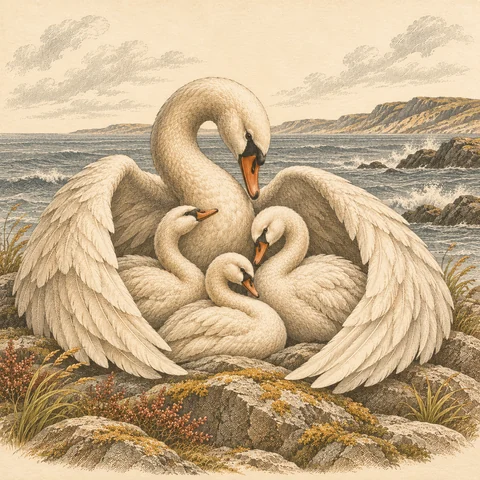
An equipped challenger
Joyce introduces Lugh, whom he calls Luga, arriving with marvelous equipment associated with Manannán. His resistance to the Fomorian tribute collectors gives him a public role as champion before the murder of his father redirects the narrative. The same figure therefore acts for a threatened community and pursues a deeply personal grievance, with no guarantee that the two purposes will remain equivalent.
Source: The Fate of the Children of Turenn — Joyce adaptation · The Fate of the Children of Turenn, chapters I–II: arrival, borrowed equipment, tribute collectors and Cian’s mission
A fine whose explanation comes late
At Tara, Lugh obtains agreement to apparently manageable objects before revealing their extraordinary identities and dangerous owners. The public guarantees secure compliance. Later he causes the brothers to forget the remaining tasks so that they surrender the useful treasures before attempting the final, fatal challenges. Formal adherence to a list can thus coexist with a strategy designed to prevent reconciliation.
Source: The Fate of the Children of Turenn — Joyce adaptation · Chapters IV and XII: naming and explaining the fine, guarantees, induced forgetting and first return
The power not to heal
When the brothers complete the terms, Lugh refuses the apples that could save them. His father's death remains a grievance beyond material payment. The ending does not require readers to deny the original murder's cruelty in order to notice the cruelty of refusing a cure. This account concerns Joyce's particular quest narrative and does not substitute for Lugh's many other literary appearances.
Source: The Fate of the Children of Turenn — Joyce adaptation · Chapter XV: Turenn’s appeal, Brian’s appeal and Lugh’s refusal
- Period / witness
- Irish literary romance in Joyce’s historical adaptation; the consulted printed edition is dated 1920.
- Recording context
- Read through P. W. Joyce’s Old Celtic Romances, a literary translation and adaptation whose preface acknowledges freely recast wording, comparison of manuscript copies, and added chapter divisions. The 1920 print witness is distinct from the age of its underlying tale.
A recording location is not necessarily a story’s origin. Dates of texts, copies, and translations answer different questions.
Explore time & place →Read the sources
These references support the explanation above. Rights and edition notes are recorded individually.
The Fate of the Children of Turenn — Joyce adaptation ↗
Irish literary narrative; translated and adapted by Patrick Weston Joyce (1827–1914) · Consulted print edition dated 1920; preface to the third edition dated 1907; Project Gutenberg release 17 November 2011
Edition & rights note