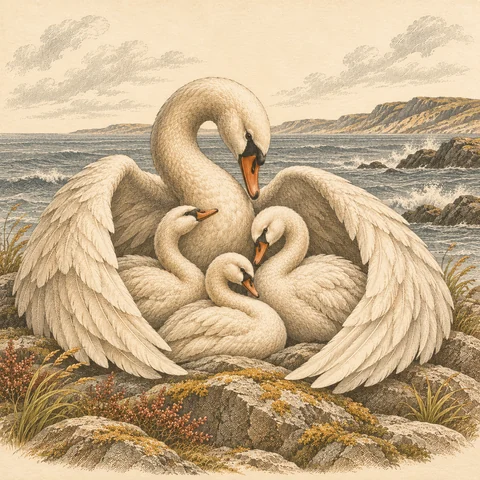
A return offered as a choice
In the Sick-Bed, Manannán recognizes Fand's predicament and comes to her after the confrontation with Emer. He asks whether she will accompany him or remain. Fand chooses to leave, giving her reasons in direct speech. The scene makes him part of the restoration of a relationship, while preserving the woman's response rather than depicting her as an object silently retrieved.
Source: The Sick-Bed of Cuchulain — Leahy translation · The Sick-Bed of Cuchulain: Manannán’s approach, offer and Fand’s answer
The boundary after the separation
The ending associates Manannán with the cloak that prevents Fand and Cú Chulainn from meeting again. Its function is specific: it closes a connection that has injured two households. The narrative also uses drinks of forgetfulness for the human couple. These coordinated endings make separation an active intervention, not simply the assumption that supernatural and human people can never meet.
Source: The Sick-Bed of Cuchulain — Leahy translation · The Sick-Bed of Cuchulain: drinks of forgetfulness and final cloak
An owner behind another hero’s resources
Joyce's Tuireann tale gives Lugh Manannán's horse and equipment, then makes his boat available for the brothers' quest. The vessel responds to commands and expands beyond its apparent capacity. This is a separate adapted witness with its own plot. Its inventory can be compared with the Sick-Bed's boundary-making cloak without treating every magical object as evidence for one complete, standardized divine biography.
Source: The Fate of the Children of Turenn — Joyce adaptation · The Fate of the Children of Turenn, chapters I and V–VI: equipment, loan request and boat’s properties
- Period / witness
- Medieval Irish prose and verse preserved in medieval and early modern manuscript witnesses; Leahy translation 1905–1906. Joyce’s Tuireann narrative is a separately mediated historical adaptation.
- Recording context
- This entry concerns the literary version named in its passages, transmitted by Christian-era Irish manuscript culture and translated by A. H. Leahy. Legendary settings are not dates of composition or evidence for a single pre-Christian canon. The Tuireann sections use Joyce’s 1920 print witness and retain its adaptation boundary.
A recording location is not necessarily a story’s origin. Dates of texts, copies, and translations answer different questions.
Explore time & place →Read the sources
These references support the explanation above. Rights and edition notes are recorded individually.
The Sick-Bed of Cuchulain — Leahy translation ↗
Anonymous Irish literary narratives; translated and arranged by Arthur Herbert Leahy (1857–1928) · Volume I, 1905; Project Gutenberg eBook released May 2004 and updated 29 June 2026
Edition & rights noteThe Fate of the Children of Turenn — Joyce adaptation ↗
Irish literary narrative; translated and adapted by Patrick Weston Joyce (1827–1914) · Consulted print edition dated 1920; preface to the third edition dated 1907; Project Gutenberg release 17 November 2011
Edition & rights note