Strength capable of disabling itself
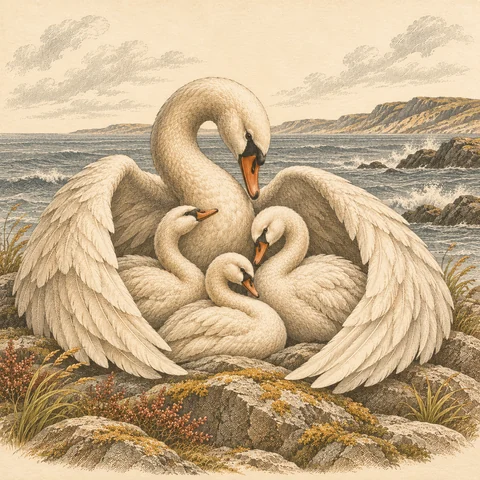
The Sick-Bed begins with Cú Chulainn treating extraordinary birds as an opportunity to fulfill a promise. He attacks despite warnings and suffers a prolonged collapse after the women's vision. Later, his success in Labraid's battle produces another danger: his heat and aggression require cooling. The tale presents excessive force as something companions must manage, not merely a gift they celebrate.
Source: The Sick-Bed of Cuchulain — Leahy translation · The Sick-Bed of Cuchulain: chained birds, illness, Labraid’s battle and cooling vats
Dependence on others’ judgments
Láeg travels ahead to investigate the otherworld, and women provide the access and knowledge the warrior lacks. Emer criticizes the community for failing to secure his recovery. Those relationships complicate an image of the solitary hero: his ability to act depends on messengers, caregivers, guides, and a household whose injuries cannot be solved by killing another opponent.
Source: The Sick-Bed of Cuchulain — Leahy translation · The Sick-Bed of Cuchulain: Láeg’s journeys, Lí Ban’s protection and Emer’s speeches
A future he insists on contesting
In the cattle prelude, the Morrígan predicts interventions against him, but he answers each with a threat of his own. The dialogue gives supernatural foresight an argumentative setting rather than presenting a neutral schedule of events. These entries concern selected Leahy witnesses; they do not supply the champion's complete birth, training, war service, and death from an artificially unified biography.
Source: The Apparition of the Great Queen to Cuchulain — Leahy translation · Táin Bó Regamna, literal translation: bird disclosure, coming Táin and paired threats
- Period / witness
- Medieval Irish prose and verse preserved in medieval and early modern manuscript witnesses; Leahy translation 1905–1906.
- Recording context
- This entry concerns the literary version named in its passages, transmitted by Christian-era Irish manuscript culture and translated by A. H. Leahy. Legendary settings are not dates of composition or evidence for a single pre-Christian canon.
A recording location is not necessarily a story’s origin. Dates of texts, copies, and translations answer different questions.
Explore time & place →Read the sources
These references support the explanation above. Rights and edition notes are recorded individually.
The Sick-Bed of Cuchulain — Leahy translation ↗
Anonymous Irish literary narratives; translated and arranged by Arthur Herbert Leahy (1857–1928) · Volume I, 1905; Project Gutenberg eBook released May 2004 and updated 29 June 2026
Edition & rights noteThe Apparition of the Great Queen to Cuchulain — Leahy translation ↗
Anonymous Irish literary narratives; translated and arranged by Arthur Herbert Leahy (1857–1928) · Volume II, 1906; Project Gutenberg eBook released May 2004 and updated 29 June 2026
Edition & rights note