An observer before a fighter
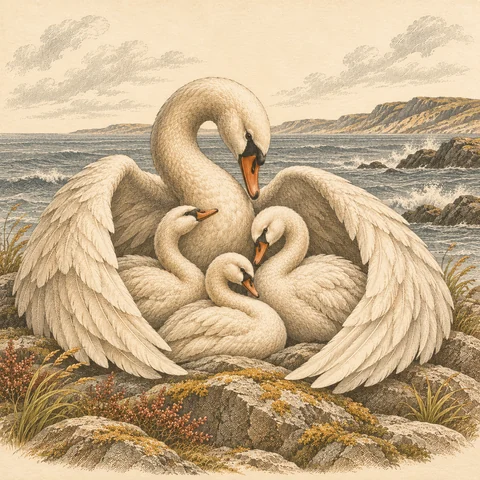
Láeg warns Cú Chulainn about the chained birds whose power seems unlike that of ordinary quarry. His warning fails to prevent the attack, but it establishes a difference between recognizing a danger and possessing the authority to stop it. The charioteer is repeatedly near the decisive action without controlling his master's response to what they see.
Source: The Sick-Bed of Cuchulain — Leahy translation · The Sick-Bed of Cuchulain: warning before the attack on the chained birds
Access granted by a woman
Sent to investigate the otherworld, Láeg travels under Lí Ban's protection. Their exchange makes him acknowledge a dependence unfamiliar to his usual martial role. He observes the palace, its inhabitants, and its hospitality, then reports to Cú Chulainn. His account helps persuade the sick hero to travel, making description itself an instrument that changes the course of events.
Source: The Sick-Bed of Cuchulain — Leahy translation · The Sick-Bed of Cuchulain: first journey with Lí Ban and reports on Labraid’s dwelling
Knowing when strength needs restraint
After the battle Láeg fears that Cú Chulainn's unsatisfied aggression may turn on his allies and advises cooling him in successive vats. In the Morrígan prelude he also arrives ready to follow the alarming sound that wakes the hero. These scenes give companionship a practical dimension: equipment, transport, warning, and containment support the spectacular deeds that receive public renown.
Sources: The Sick-Bed of Cuchulain — Leahy translation; The Apparition of the Great Queen to Cuchulain — Leahy translation · The Sick-Bed of Cuchulain: advice after Labraid’s battle; Táin Bó Regamna: harnessed chariot and pursuit of the cry
- Period / witness
- Medieval Irish prose and verse preserved in medieval and early modern manuscript witnesses; Leahy translation 1905–1906.
- Recording context
- This entry concerns the literary version named in its passages, transmitted by Christian-era Irish manuscript culture and translated by A. H. Leahy. Legendary settings are not dates of composition or evidence for a single pre-Christian canon.
A recording location is not necessarily a story’s origin. Dates of texts, copies, and translations answer different questions.
Explore time & place →Read the sources
These references support the explanation above. Rights and edition notes are recorded individually.
The Sick-Bed of Cuchulain — Leahy translation ↗
Anonymous Irish literary narratives; translated and arranged by Arthur Herbert Leahy (1857–1928) · Volume I, 1905; Project Gutenberg eBook released May 2004 and updated 29 June 2026
Edition & rights noteThe Apparition of the Great Queen to Cuchulain — Leahy translation ↗
Anonymous Irish literary narratives; translated and arranged by Arthur Herbert Leahy (1857–1928) · Volume II, 1906; Project Gutenberg eBook released May 2004 and updated 29 June 2026
Edition & rights note