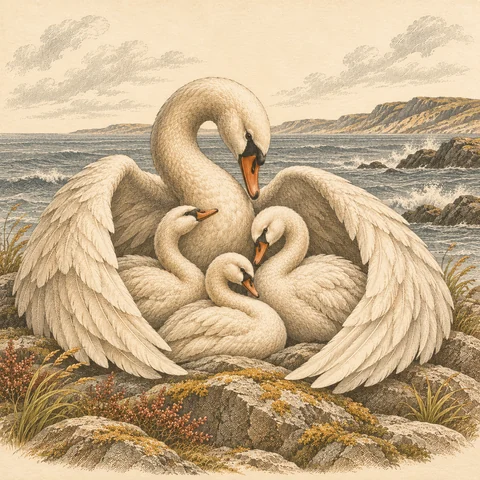
Jealousy inside an allied household
In Joyce's telling, Lir's marriage to a foster-daughter of Bodb Derg reconciles him with the newly chosen ruler. After she dies, her sister becomes Lir's second wife and initially cares tenderly for the four children. Their father's affection and the wider community's delight in them eventually provoke her jealousy. Joyce calls the sisters Eve and Eva, English forms belonging to his adaptation.
Unable to persuade attendants to kill the children, and unable to strike them herself, Eva transforms them into swans while they bathe. Fionnuala, named Finola in this translation, demands to know the duration. Three successive periods of three hundred years are assigned to a lake, the Sea of Moyle, and western waters. Their eventual release is tied to a royal union and the coming of Christianity.
Source: The Fate of the Children of Lir — Joyce adaptation · The Fate of the Children of Lir, chapters I–III: election, marriages, jealousy, transformation and conditions
The work of staying together
The children retain human speech, reason, and extraordinary music. Their father learns the truth, and Bodb punishes Eva by changing her into a demon of the air. Yet neither powerful adult can undo the enchantment. The first lake period allows conversation with friends; the northern sea brings storms, hunger, and injuries when feathers and feet freeze against a rock.
Fionnuala repeatedly organizes survival. She appoints a meeting place before a storm and shelters her brothers under her wings and against her breast. After the final western period, they visit their former home and find only ruins. The passage of centuries has removed the household to which they hoped to return, making the end of the sentence a further encounter with loss.
Source: The Fate of the Children of Lir — Joyce adaptation · Chapters IV–VI: Eva’s punishment, lake companionship, Moyle storms, western waters and ruined home
Release without recovered youth
The swans hear a Christian bell and come under the care of Kemoc. When a queen demands the marvelous birds, her husband tries to take them by force. Their feathers disappear, revealing four extremely aged people. Fionnuala asks for immediate baptism and burial in the arrangement that recalls how she sheltered her brothers. They die, and Kemoc sees a vision of children ascending joyfully.
The ending is explicitly Christian, not a modern promise that sufficient endurance restores everything lost. Joyce's prefatory discussion identifies the manuscript copies he used as eighteenth-century witnesses; that copying history must remain distinct from the tale's legendary antiquity. His freely phrased literary version is the account explained here, rather than a claim to reproduce an untouched ancient original.
Source: The Fate of the Children of Lir — Joyce adaptation · Chapters VI–VII: Kemoc, royal seizure, aged human forms, baptism and burial; preface, The Fate of the Children of Lir
- Period / witness
- Irish literary romance in Joyce’s historical adaptation; the consulted printed edition is dated 1920.
- Recording context
- Read through P. W. Joyce’s Old Celtic Romances, a literary translation and adaptation whose preface acknowledges freely recast wording, comparison of manuscript copies, and added chapter divisions. The 1920 print witness is distinct from the age of its underlying tale.
A recording location is not necessarily a story’s origin. Dates of texts, copies, and translations answer different questions.
Explore time & place →Read the sources
These references support the explanation above. Rights and edition notes are recorded individually.
The Fate of the Children of Lir — Joyce adaptation ↗
Irish literary narrative; translated and adapted by Patrick Weston Joyce (1827–1914) · Consulted print edition dated 1920; preface to the third edition dated 1907; Project Gutenberg release 17 November 2011
Edition & rights note