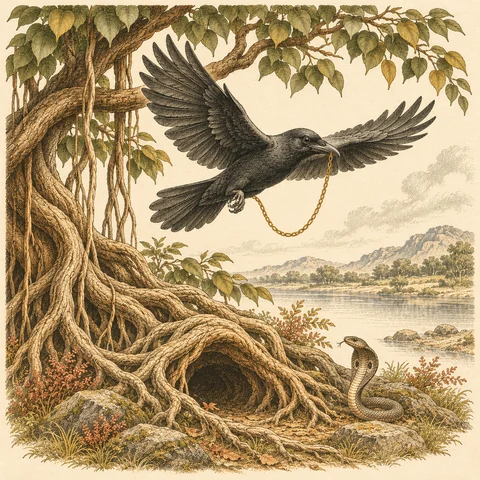
A resource beyond immediate reach
Supersmart finds an elephant that has died naturally in the forest. There is ample meat, but he cannot pierce the thick hide. Possession of the discovery therefore does not yet mean access to the food. He must also manage the other carnivores that begin arriving.
When a lion appears, the jackal presents himself as a humble guardian keeping the carcass for his king. The lion declines to eat something killed by another and grants it to him. Deference has removed the most imposing claimant. The elephant’s actual natural death remains distinct from the explanations Supersmart will subsequently offer to creatures he wants to frighten or recruit.
Source: Panchatantra, Book 4: Loss of Gains · Panchatantra, Book 4, How Supersmart Ate the Elephant, pp. 418–421
One claim repurposed twice
A tiger comes next. Supersmart now says that the lion killed the elephant, left him on guard, and harbors a particular hatred of tigers that steal his prey. The frightened visitor asks not to be reported and leaves.
A leopard presents a different opportunity because its teeth can cut the hide. The jackal offers it a quick meal before the supposed lion-owner returns and promises to keep watch. After initial hesitation, the leopard begins feeding. As soon as an opening has been made, Supersmart raises a false alarm that the lion is approaching. The leopard flees, leaving the jackal with both the carcass and the means of entering it.
Source: Panchatantra, Book 4: Loss of Gains · Panchatantra, Book 4, How Supersmart Ate the Elephant, pp. 418–421
No single method for every encounter
Finally another jackal arrives. Treating this competitor as an equal whose strength he can estimate, Supersmart attacks and drives it away. He then eats comfortably for an extended period. His success depends on alternating submission, intimidation by report, a conditional invitation, and direct force.
The episode makes strategy responsive to the other party’s capacities and expectations. The leopard is not simply excluded like the tiger; it must first be persuaded to perform useful work. At the same time, the clever plan is exploitative: its promised hospitality lasts only until the host obtains what he needs. The story illustrates the difference between understanding another’s interests and honoring them, a distinction that remains visible beneath the triumphant closing meal.
Source: Panchatantra, Book 4: Loss of Gains · Panchatantra, Book 4, How Supersmart Ate the Elephant, pp. 418–421
- Period / witness
- Pūrṇabhadra recension dated 1199 CE; Arthur W. Ryder translation, 1925. The tales have differing earlier histories.
- Recording context
- Original synopsis and commentary on Ryder’s translation of the Pūrṇabhadra recension, edited by Johannes Hertel. This selected literary witness does not represent all Indian traditions.
A recording location is not necessarily a story’s origin. Dates of texts, copies, and translations answer different questions.
Explore time & place →Read the sources
These references support the explanation above. Rights and edition notes are recorded individually.
Panchatantra, Book 4: Loss of Gains ↗
Pūrṇabhadra recension (1199 CE); English translation by Arthur W. Ryder (1877–1938), based on Johannes Hertel’s Sanskrit edition · Pūrṇabhadra recension 1199 CE; Hertel edition 1908; Ryder translation 1925
Edition & rights note